Showing posts with label Android. Show all posts

Saturday, 6 April 2013

How to Create Your Android or iOS Application Without Coding

With the huge number of mobile applications in Google Play and App Store and how they make our mobile phones more useful, you can’t help but assume that one must be a fully qualified programmer with years of experience to create a productive mobile application. From learning the basics of programming to writing the codes out, it’s probably a pretty tough thing but did you know you can create a nice little mobile app without knowing a damn thing about programming? Although it may not be as professional as those ones you see at Apple Store but still, you can create something for your personal use and even share with friends.
Must Read: Android Based Devices and iPhone – Which is Better?
Some sites offer this service for free, allowing you to create your own Android or iOS application for free and the good news is that you’re not required to be a programmer, you may not even know a bit of code. So, how does this sites work?
Must Read: Top 5 Android HD Games For 2012
The sites offering this service have different web applications you can run in your browser with an understandable GUI you can easily use to create your app. It can be as simple as a drag-and-drop process which can really be fun.
1. Appsbar
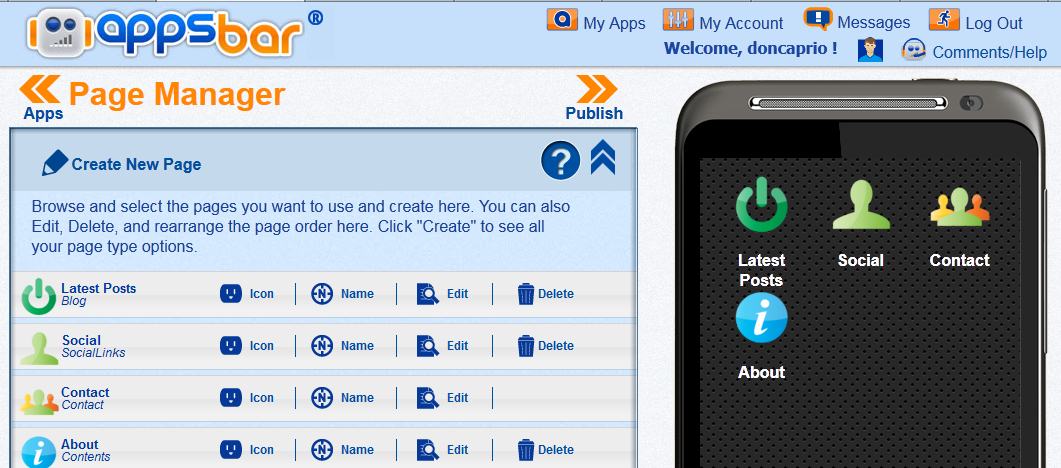
create your android or iOS app without coding
Appsbar is quite easy to use and they offer some robust tools to help you create your mobile application. i had the time to use it for a while and I can say that the service they offer for free is quite a great one. A regular person who doesn’t even know how programming works should be able to create a nice app using the tools they offer. There are predefined options but you can make your app look just how you want it by uploading your own icon, splash screen, and so on. As a blogger, you may want to have your blog’s RSS feed in your application and Appsbar makes this possible. Why not check out the app I create here?
2. Capriza
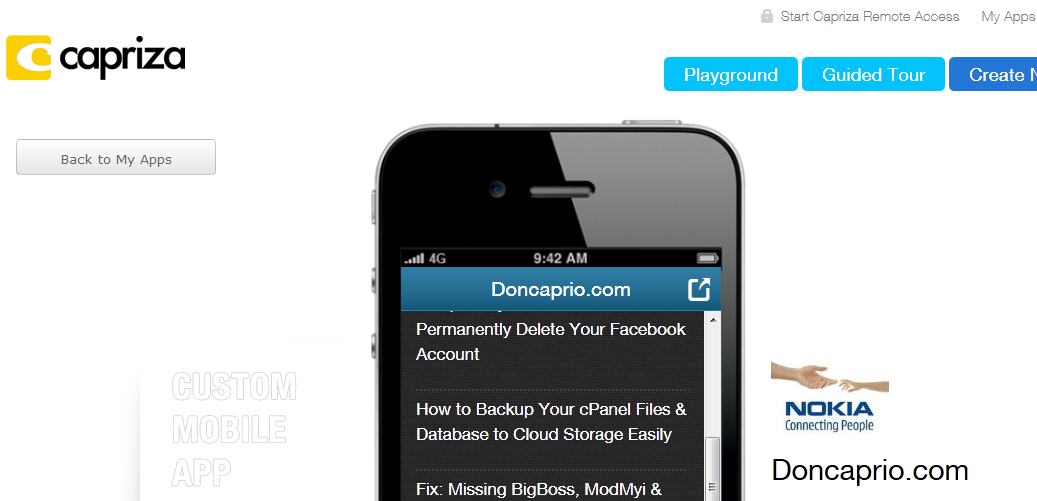
create iOS or Android application
I accidentally came across Capriza yesterday and I had the time to use if for a while. You’re made to install a Firefox addon that you can lauch any time you feel like creating a mobile web app. The tutorial you first go through is enough to guide you in creating your own application by using bits and pieces of page elements from a standard web page. It’s isn’t that hard to use as well.
3. AppMakr
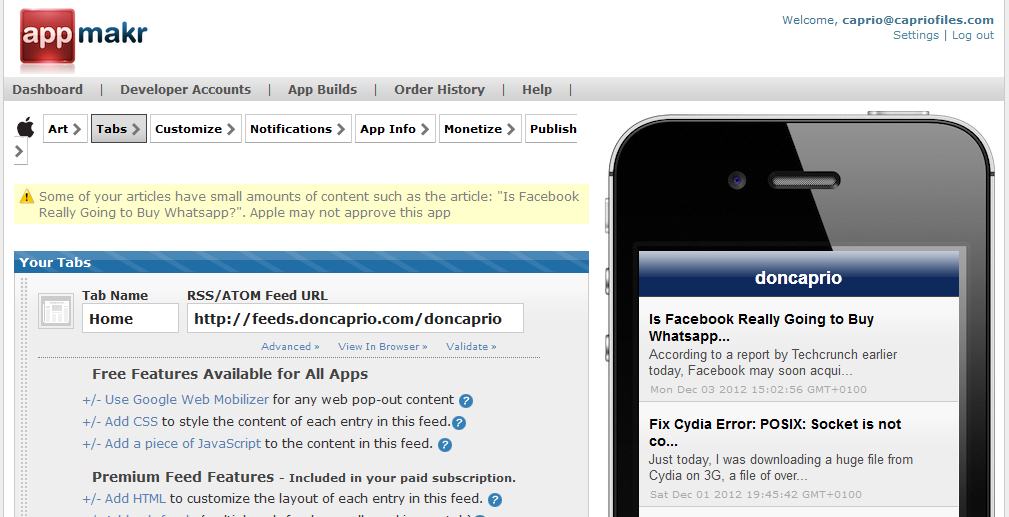
create mobile for free
AppMakr is a great platform that lets you publish your app like a real developer. The offer premium service you can subscribe to if you want the the best out of it but the free service they provide too is enough if you just want a simple mobile app.
Others include:
4. TheAppBuilder
5. iBuildApp
Of course, these services are free and easy to use but there are still some limitations. You possibly can’t create complex apps or 3D games without some real coding involved but all the same, you can still make something out of these mobile app builders if you really want to.

Google Adsense, Media.net & Addynamo: Which One is the Best?

Google Adsense as you know is one of the most reliable contextual advertising company publishers use in making money online, I guess that’s not new. Is it? Addynamo on the other hand was launched not quite long ago but is making waves on the internet. They do this not only with their contextual advertising program only, but also with their sponsored tweets program which lots of people have been benefiting from, whether you are a blogger or not. Another very strong contextual advertising company on the way is Media.net.

Google adsense is facing a great competition, and if not that they’re well reputed, if not that they have lots of advertisers – one out of these two (Addynamo or Media.net) would probably have taken the lead over them. It’ll be a tough job to overtake Google Adsense though, some reasons are; time of being in operation, reputation, amount of advertisers they serve, program policies… and by the way; webmasters, bloggers and advertisers using Adsense also have a natural love and trust for them, it’s just natural that not everyone will love a thing.
Must Read: 7 Reasons Why Your Google Adsense Earning is Low
Before pushing further I’d like to say that; this article is not written to condemn adsense, overhype addynamo, Media.net or vice versa. But to outline some important features of these three companies and the service they render as well as their good and grey sides.

Google Adsense

Google adsense as you must have already known, is a contextual advertising company that supports adsense for content, adsense for search and adsense for mobile. It also supported adsense for feed which was recently shut down. Among all listed products, you only make more money on adsense for content and sometimes from mobile, but even at that, you must get your fingers dirty before you can make good money from it. First, getting into Google adsense is almost as difficult as putting an elephant’s head through a needle’s eye, secondly, maintaining your adsense account is no less, they hit you once you go against their written program policies. What a horror!
Must Read: 5 Easy Ways to Make Money with your Blog
Not trying to scare or discourage you here – most especially if you don’t have an adsense account yet. Adsense may be difficult to get and maintained, but not impossible. And on the other hand their pay is highly attractive. In protecting your account, all you need do is read and abide by Google Terms of Service, adsense program policies and ask questions on forums about how you can protect your adsense account, why people were banned and how to prevent such mistakes – There are several people who’ll be willing to give you facts about it.

Media.net

Media.net Contextual Ads program enables web publishers to easily and effectively earn advertising revenue. The company is powered by three giant companies; Microsoft, Yahoo and Bing making it a very strong rival to Google adsense, with Media.net in the game, adsense should be very careful and should take it easy with their customers. People using the program are not complaining about their CPC cos it’s satisfactory, but adsense pays more though. Their complaints are bent on different things, some are; Media.net only accepts websites on manual review (takes 24 hours), they must manually review every single site you want to place their ads on unlike adsense that allows you to add adsense to all your web pages including your articles on web 2.0 sites (e.g hubpages.com) after getting just one adsense account, they sometimes do not approve micro-niche sites and some other flimsy excuses… The service of this company is simply good but can’t be compared with adsense, may be that’s for now. They beat Google adsense with their live customer support though.
Must Read: 10 Reasons why You’ve not Made Money Online as a Blogger
Here’s something you’d like to know about Media.net, their kind of link list ad unit is built on a floating bar, see image below:

With this kind of ad placement you’ll get lots of clicks, I mean lots of it. Media.net could be a good alternative to Google, most especially for the reason that their ads are more like menus and not like Google’s format of adverts which carries “Ads by Google” of “AdChoices”, this is almost known to all internet surfers and is going hackneyed.
Summary:

Reasons why I prefer Google than media.net: Google has a large network of ads; covering several niches, countries, they also pay better; Media.net is bent on accepting sites with most of their traffic coming from the US and the UK – This is not Google, Google covers more countries.
Reasons why I envy Media.net users: There’s no fear of instant lose of their accounts – No insecurity, they get good (live) customer support, the floating ad unit rocks.

Addynamo

Addynamo is awesome at accepting new applications, they accept any application. Even if your site is not yet driving much traffic, they accept you. You don’t also have to sweat yourself over getting banned; I have never heard that anyone got banned from Addynamo, someone may have been banned but not one that I know. Addynamo is easy to get and maintained, they equally pay publishers well. But their pay is slightly not as attractive as the one of Google adsense too. Standard websites uses them; I have seen addynamo ads on Makeuseof.com and Facebook.com. Secondly, Addynamo sponsored tweets is fun. If you have a Twitter account, you can participate as a Twitter Publisher with Addynamo, and get paid by advertisers to promote topics you support.
Must Read: How To Cheat On google Adsense
You’ll have to link your twitter account, once you’ve done that; you will receive notifications via email every time an advertiser loads a campaign for you to respond to. You can accept or decline the brief & set the price you want to be paid. It’s that simple! But I’ve had friends who testified with screenshot of making $1000+ from addynamo sponsored tweets. No rush! I know you want to go and register with them right away. But here’s what’s required, a fat twitter account, I mean you must have lots of followers. Once you have a good number of followers, Addynamo sponsored tweets will be just fun throughout.
Putting it together

Google seems strict (they’re certainly not bad) but all that strict side of them is just to protect their business and advertisers’ interest, there’s no live customer support cos of the numbers of publishers they have. Addynamo may be a good alternative plus it looks easier to operate than Google Adsense but Adsense simply pays more. Media.net is almost as good as adsense. These three companies as you can see are all great. Your decision should be the one to use at a particular time, if Google shows off, go take Media.net. If Media.net shows off, Addynamo is there to receive you anytime. They pay Nigerians in naira.

Choosing the Perfect Domain Name for Your Blog or Business Website

Choosing a blog name is one thing that any blogger shouldn’t rush into because a blog name is the first foundation for building a successful blog. In this article I will be sharing with you the important steps to follow when choosing a blog name or domain name for your business either online or offline.
how to choose a good domain name

Step by step guide on how to choose a perfect blog name or domain name

When it comes to choosing a domain name for your new blog or offline/online business, most people get confused as what they plan to use is already taken by someone else. It’s for this reason people go with wrong domain names but before you choose, you should consider these few points.

It should be short

A short blog name or domain name is easy to remember than a long domain name, only choose a name that will be easily remembered by your blog visitors in case they want to revisit your blog again. Remember that not all blog readers will remember your blog url or name if it is too long so always go for a short and easy to remember blog or domain name.
Must Read: 10 Important Points To Write a Great Blog Post

The name should be self descripsive

Your blog name should be able to describe what your blog is about to your blog readers an example of a descriptive domain name is dailyblogtips.com. This is a self descriptive domain name which tells every first time visitor what the blog is about. A descriptive domain name describes what your blog is about to a first time visitor just at the first sight of the domain name, people can figure out what your blog is about if it is self descriptive and they will be patient to read your blog if they are interested in what blog url stated to them.
Must Read: How Many Blogs Should You Have to Make Money Online?

Register a .com domain name

A .com domain is the most visited extension of a blog and almost all popular blogs focus on a .com domain name. When browsing on the internet, most internet surfers usually type every domain name with a .com extension at the end because they are too familiar with it. It is the most popular and most used extension so it’s much more preferable.

Easy spellings

You should consider using an easy to spell word for your domain name, you can use a word from English or let’s something from the dictionary. This will help people know the spelling of your domain name because some blog names are very hard to spell e.g pagamaragrasive.com which is very difficult to spell and remember. For this reason, you must consider choosing a name that’s easy to spell.

No hypens

To me, hypens are considered as a pretty bad practice for a domain name. It makes a blog lose most of its daily, monthly, and even yearly blog visitors for nothing. A domain with hypens looks like this blogging-foundation.com and most times, users forget to add this hyphen.
This tips will guide you in choosing a perfect blog name or domain name for your business, a perfect name is a perfect business foundation, and remember a perfect name is the first foundation for any blog or website. Make sure you carefully choose a perfect domain name either for your online or offline business.
My question for you: What name have you decided or chosen for your blog and how perfect is the name? Share your thoughts with us.
If you enjoyed this article make sure you share this post with friends.

Android Based Devices and iPhone – Which is Better?

It’s a really hard thing to do trying to determine which platform is better between Android and iOS because both have their pros and cons. If you’re an Apple freak, you will be of the opinion that there’s nothing comparable with your iPhone but the same thing goes for Android OS users. I’m using an iPhone but I plan on getting an Android smartphone in the near future, not because my iPhone doesn’t serve purpose, but because there are certain things I love in Android OS as well. I love my iPhone, there’s no doubt about that but that won’t blind me from telling the truth about these two mobile operating systems.
Even though I don’t personally use an Android device on a day to day basis, I know all about it because I’m quite used to it and can tell the difference. Steve Wozniak, Apple co-founder, admits there are certain things he wish his iPhone does but couldn’t. “My primary phone is the iPhone,” Steve Wozniak says. “I love the beauty of it. But I wish it did all the things my Android does, I really do.”
android vs iphone - which is better?Now, that’s a real tech guy talking. Let’s weigh the pros and cons one after the other before judging which of the platform you should really go for.
1. iOS is exclusive to Apple, Android is open source
With Android being an open source platform, it means there’s open market, open environment and development of the OS is open to anyone. This sounds good but there are certain things to consider. iOS is exclusive to Apple and Apple alone and this means you are limited by the rules Apple set, install only what they approve of and so on (unless you jailbreak your device).
The disadvantage of Android being an open source platform is that it’s open to malwares. There has been lots of issues lately about how insecure Android OS can be and more specifically, cybercriminals have entered the practice of developing malicious apps and sneaking them into the app marketplace to place unsuspecting victims into their web.
This is a the major edge iOS has over Android and like I mentioned before, so far your phone is not jailbroken and you download apps from iTunes store, your mobile device is secure.
2. With iPhone, there are less devices to choose from, with Android, the range of available devices is huge
This is another factor to consider. iPhone is iPhone and will always be iPhone and that’s never going to change. If you’re going for a device running iOS, it has to be from Apple. Android OS is available on several devices in various sizes and shapes. You can decide to go for an Android phone with a real keyboard, a portable phone that isn’t so bogus, a non-touch screen phone and so on. It could be from Samsung, HTC, LG or which ever manufacturer you choose. The choice of device is all yours.
With iPhone, you only have a few devices to choose from, depending on your money.
3. When it comes to design, Apple wins
When it comes to design and longevity, iPhone has that and till date, no smartphone manufacturer can beat that. Though there are are countless smartphones out there, the uniqueness and beauty of iPhone is unrivaled.
4. You can’t customize your iPhone (unless jailbroken)
This is a major disadvantage of iOS, you can’t customize it and that sucks pretty bad. There are tons of customizations available for Android users but if your iPhone is not jailbroken, you’re probably stuck with what Apple has to offer.
Like I mentioned earlier, it’s a different case if your device is jailbroken. There are lots of customizations available through Cydia repositories but the fact is that not all users are willing to take the chance of jailbreaking their iPhone and void their warranty. The bottom line is this: customization too is available for iPhone and mine has been functional than any Android phone I know of since I jailbroke it. Android users too need to root their phones to get certain things done.
5. When it comes to fluidity and responsiveness, iPhone wins
With iPhone, the user interface leverages the hardware in a way that Android doesn’t, that explains why iPhone is easier to navigate. It’s even been said that iPhone 4s with dual core processor is faster than the new Samsung Galaxy S III with quad core processor. I don’t know how far this is true and if it’s only a rumor but the fact remains that iOS UI is more user friendly.
6. There are dead cheap Android phones, iPhone is expensive to lots of people
No matter how much you have, you can always get an Android smartphone and this is one of the reasons Android is a lot better than iOS. I’ve seen lots of people settling for Android devices because they can’t afford an iPhone and in due time, this may increase Android popularity over iOS.
There are lots of more points to consider but I’m not so sure I can think of more for now and there are others I left out because I considered them irrelevant.
When it comes to choosing a smartphone, there are lots of things to consider and the one you go for should be dependent or the kind of user you are and what you want out of your phone. iPhone rocks in its own way, so does Android. I used to be a Symbian freak (a part of me still is) but for now, I’m an Apple fan and I need to upgrade this crappy iPhone 3G to 4S first before thinking of getting an Android device :P
I must admit, though, that Google was smart in taking over Android development and making it open source. It gives power to the user in a lot of ways Apple never will. That’s why the jailbreaking community is growing daily…consumers need a lot more.
With Android and iPhone battling it out, the consumer wins. As they say, nothing brings out the best in products like competition.
Choosing the better platform between Android and iOS is nothing but fan discussion. Bother are the most used and powerful mobile OS platforms and the one you stick to is a matter of which one meets your daily needs better.

iOS versus Android: the app arms race

In the aftermath of the release of the Samsung Galaxy S4 last week, and Apple’s marketing backlash, the iOS vs Android arms race has hit a milestone. Android is growing faster than ever, in terms of both their market share and the revenue they pay out to app marketers. Apple’s marketing has taken on a decidedly ‘attacking’ tone. ‘There’s iPhone. And then there’s everything else’ is clearly mirroring the phrase, ‘Here’s the best, forget the rest’. It’s about time, we thought, for an infographic on the iOS vs Android feud as it stands now. Which is the best platform for app marketers? Let’s consider some factors, or scroll down to view our infographic right away.

Smartphone and tablet market share

Some contests seem to have been won by Android categorically. Last month, the worldwide smartphone market share figures stood at 69.2% (Android) and 22.1% (iOS). These current figures are actually more in Apple’s favor than the October figures (75% and 15%), due to the release of the iPhone 5. But now the S4 is here, it’s likely we’re going to see the gap widen again.
On other counts though, iOS is the reigning champion. While Android also takes the lead in terms of tablet market share and smartphone app downloads, albeit with smaller margins, iOS is far, far ahead in terms of tablet app downloads; which must be due to the fact that there are over 275,000 optimized for the full-size iPad and iPad mini.

iOS vs Android app revenue and monetization

It is also a widely known and inescapable fact that, on the whole, iOS apps monetize much better than Android apps. The type of user that iOS attracts (and nurtures) are high earning and very engaged users. But that’s not to say the situation isn’t changing for Android.
While iOS pays out four times as much revenue to app marketers than Android, app revenue growth is growing five times more rapidly on Android. But will it stay this way so that Android can catch up and even overtake iOS? This remains to be seen, as we watch the battle of the platforms progress.

The life of the app marketer

In terms of the day-to-day of marketing apps on the respective platforms, iOS is a less fragmented platform with higher app marketing costs but greater profits for advertisers. It is also much easier and more predictable to carry out iOS App Store ranking boost campaigns due to the ranking algorithm being more heavily weighted on download volumes than an intransparent selection of factors. On Android, we see a more complex and fragmented reality for app marketers.
We created the following infographic to compare iOS and Android in terms of market share, user demographic and app marketing.
There’s a myriad of points on which you can compare the two platforms, and on reflection I think the conclusion must be this: both are winners in their own ways. Highly democratic I know, but that is how it is. Final words: Compare everything and identify and support the platform that’s right for your app.

Friday, 5 April 2013

Facebook aims to take centerstage on Android phones

MENLO PARK, California (Reuters) - Facebook Inc on Thursday unveiled its most ambitious attempt yet to enter mobile computing without a phone of its own, introducing a new app that replaces the home screen on some Android smartphones.
Called "Home," the new software lets users comprehensively modify Android, the popular mobile operating system developed by Google, to prominently display their Facebook newsfeed and messages on the home screens of a wide range of devices - while hiding other apps.
"Why do we need to go into those apps in the first place to see what's going on with those we care about?" Facebook Chief Executive Mark Zuckerberg told the hundreds of reporters and industry executives gathered at the company's Menlo Park campus.
"We want to bring all this content to the front."
The "Home" software will be available for download for free from Google Play starting April 12. In addition, AT&T Inc has exclusive rights to sell for $100 the first handsets, made by Taiwan's HTC Corp, that come pre-installed with the software starting the same day. France Telecom's Orange will be offering the phone in Europe.
Shares in Facebook finished trading up 82 cents, or 3.1 percent, at $27.07; Google stock closed at $795.07, down $11.13 or 1.38 percent.
Analysts say should the new software take off, it may begin to draw users away from Google services. Offering Facebook messaging, social networking and photos on the very first screen that Android users see could divert attention from the panoply of services, such as search and email, which generate advertising revue for Google.
Instead of traditional wallpaper or a "lock screen," users with Home installed will see a new Facebook "cover feed" that displays a rolling ticker-tape of photos, status updates - and eventually, ads - from Facebook's network.
Facebook's executives, acknowledging that messaging and communications remain the most fundamental use for smartphones, also showed off a new "chat heads" messaging interface, which would combine SMS text messages and Facebook chat messages under one tool.
"On one level, this is just next mobile version of Facebook," Zuckerberg said. "At a deeper level, this can start to be a change in the relationship with how we use these computing devices."
People who used the software and the HTC phone on Thursday appeared impressed by the highly visual design and interface that featured a multitude of pictures. But analysts say the jury is still out on whether Home has appeal beyond habitual Facebook users.
Some were skeptical consumers would leap at the chance to make Facebook so central to their lives.
"Facebook thinks it's more important to people than it actually is," said Charles Golvin, an analyst at Forrester Research.
Golvin said that in markets like Spain and Brazil, mobile users spend far more time in messaging apps like Whatsapp compared to the Facebook app.
"For the vast majority of people, Facebook just isn't the be-all and end-all of their mobile experience. It's just one part," he said. "I see a more apathetic response among Facebook users than Facebook might be expecting."
COMPETITION WITH GOOGLE
Facebook's wide-reaching mobile strategy could heighten its competition with Google, the dominant Internet search engine and the developer of Android with whom it is locked in a battle for Internet users' time online and for advertising dollars. But if it proves to be popular among Android users, Home could also place the two companies in something of an uneasy partnership.
More than 750 million mobile devices featuring Android have been activated to date, according to Google, more than gadgets based on Apple Inc's iOS, the runner-up.
Zuckerberg downplayed the rivalry even as he praised Google's willingness to let other companies tinker with Android. He said he was confident Google would not make changes to Android that would hamstring Facebook.
"If 20 percent of time people are spending on their phones is in Home, I really think they're going to have a hard time making a rational decision" to limit Home's functionality, Zuckerberg told reporters.
Google issued a neutral statement, saying the new phone demonstrated Android's openness.
"The Android platform has spurred the development of hundreds of different types of devices," the company said. "This latest device demonstrates the openness and flexibility that has made Android so popular."
Not everyone is sure that Google will remain neutral.
"Google has made Android open, but as they release the next version, are they going to be as open?" said Simon Mansell, the chief executive of TBG Digital, an advertising technology provider. "Facebook is hiding all the Google stuff with their own stuff, and how Google will respond is interesting."
For Facebook - founded in Zuckerberg's dorm room in 2004 as a website - bolstering its mobile presence is critical. Nearly 70 percent of Facebook members used mobile devices such as smartphones and tablets to access its service at the end of 2012, and 157 million of Facebook's roughly 1 billion users accessed the service solely on a mobile device.
The company has stepped up efforts to ensure that its revenue-generating ads can be viewed on mobile devices and Zuckerberg has said that the company's engineers are now focused on creating "mobile-first experiences."
Zuckerberg said features like cover feed will be ad-free initially, but he envisioned advertising as another form of content that will eventually be integrated. Analysts say the company treads cautiously when introducing ads into any of its services, wary of infuriating users.
"This is about becoming more deeply embedded in the operating system on mobile devices, and creating a broader platform," said Jan Dawson, chief telecoms analyst for the research firm Ovum. "It will allow Facebook to track more of a user's behavior on devices, and present more opportunities to serve up advertising."
But "that presents the biggest obstacle to success for this experiment: Facebook's objectives and users' are once again in conflict. Users don't want more advertising or tracking, and Facebook wants to do more of both."
Reports that Facebook was developing its self-branded smartphone have appeared sporadically and Zuckerberg has shot them down, as he did again on Thursday.
But with specialized software that adds a layer on top of Android, Facebook may get many of the benefits of having its own phone without the costs and risks of actually building a hardware device, analysts said.
"It's much lower risk than developing a phone or an operating system of its own, and if it turns out not to be successful, there will be little risk or loss to Facebook," Dawson said. "If it does turn out to be successful, Facebook can build on the model further and increase the value provided in the application over time."
Wednesday, 27 March 2013

Android Apps Closing Rapidly the Revenue Gap with iOS Apps

An interview of Craig Palli from Fiksu provided some fascinating figures about how the value of iPad, iPhone and Android smartphone application users is changing as the device owner profiles shift and usage patterns evolve. Fiksu is one of the best-known mobile advertising specialists, with a client roster including brands like VH1 and Hearst Magazines. One of the most interesting trends popping up in the conversation with Mr. Palli was that two years ago, an iPhone user was worth more than twice as much as an Android smartphone user in revenue generation. A year ago, that lead shrunk to iPhone users being 50% more valuable – and right now, if the app is designed specifically for Android and some segmentation is considered, the revenue generation potential is the same.
This change coincides with the leading Android smartphone vendor, Samsung, pulling decisively ahead of Apple in smartphone volume sales and Google‘s attempts to improve the Google Play user experience in order to attract more high-value customers. As the Android market has consolidated around Samsung, the splintering problem that has been plaguing the ecosystem has shrunk.
Interestingly, the revenue generation gap between iPad and iPhone has been narrowing as well. According to Fiksu’s statistics, iPad owner is currently worth 20% more than an iPhone owner. In some app categories, iPad and iPhone now generate the same amount of revenue per user; casino applications being one prominent example.
Fiksu states that the average time consumers owning a smartphone spend on mobile apps daily is now hitting a remarkable two hours a day, up 50% over just one year. This could go some way towards explaining the harrowing recent declines in video game software sales and prime time network television audiences. Having achieved critical mass in their home countries, mobile brands are increasingly exporting their apps to new countries, according to Mr. Palli. The big Asian players such as RenRen, Tencent, DeNA, Gree and others are investing significantly in the US markets.
The rise of Android application market value relative to iOS app market is setting up a fascinating clash between the Japanese/Korean app vendors that dominate the Android landscape and the US/EU vendors that dominate the iOS market. The ones that cross over more effectively and rapidly to their secondary mobile OS may well be the app market leaders circa 2015.

Wednesday, 6 July 2011

Android

What is Android?

Android is a software stack for mobile devices that includes an operating system, middleware and key applications. The Android SDK provides the tools and APIs necessary to begin developing applications on the Android platform using the Java programming language.

Features

Application framework enabling reuse and replacement of components
Dalvik virtual machine optimized for mobile devices
Integrated browser based on the open source WebKit engine
Optimized graphics powered by a custom 2D graphics library; 3D graphics based on the OpenGL ES 1.0 specification (hardware acceleration optional)
SQLite for structured data storage
Media support for common audio, video, and still image formats (MPEG4, H.264, MP3, AAC, AMR, JPG, PNG, GIF)
GSM Telephony (hardware dependent)
Bluetooth, EDGE, 3G, and WiFi (hardware dependent)
Camera, GPS, compass, and accelerometer (hardware dependent)
Rich development environment including a device emulator, tools for debugging, memory and performance profiling, and a plugin for the Eclipse IDE

Android Architecture

The following diagram shows the major components of the Android operating system. Each section is described in more detail below.


Applications

Android will ship with a set of core applications including an email client, SMS program, calendar, maps, browser, contacts, and others. All applications are written using the Java programming language.
Application Framework

By providing an open development platform, Android offers developers the ability to build extremely rich and innovative applications. Developers are free to take advantage of the device hardware, access location information, run background services, set alarms, add notifications to the status bar, and much, much more.

Developers have full access to the same framework APIs used by the core applications. The application architecture is designed to simplify the reuse of components; any application can publish its capabilities and any other application may then make use of those capabilities (subject to security constraints enforced by the framework). This same mechanism allows components to be replaced by the user.

Underlying all applications is a set of services and systems, including:

A rich and extensible set of Views that can be used to build an application, including lists, grids, text boxes, buttons, and even an embeddable web browser
Content Providers that enable applications to access data from other applications (such as Contacts), or to share their own data
A Resource Manager, providing access to non-code resources such as localized strings, graphics, and layout files
A Notification Manager that enables all applications to display custom alerts in the status bar
An Activity Manager that manages the lifecycle of applications and provides a common navigation backstack

For more details and a walkthrough of an application, see the Notepad Tutorial.

Libraries

Android includes a set of C/C++ libraries used by various components of the Android system. These capabilities are exposed to developers through the Android application framework. Some of the core libraries are listed below:

System C library - a BSD-derived implementation of the standard C system library (libc), tuned for embedded Linux-based devices
Media Libraries - based on PacketVideo's OpenCORE; the libraries support playback and recording of many popular audio and video formats, as well as static image files, including MPEG4, H.264, MP3, AAC, AMR, JPG, and PNG
Surface Manager - manages access to the display subsystem and seamlessly composites 2D and 3D graphic layers from multiple applications
LibWebCore - a modern web browser engine which powers both the Android browser and an embeddable web view
SGL - the underlying 2D graphics engine
3D libraries - an implementation based on OpenGL ES 1.0 APIs; the libraries use either hardware 3D acceleration (where available) or the included, highly optimized 3D software rasterizer
FreeType - bitmap and vector font rendering
SQLite - a powerful and lightweight relational database engine available to all applications

Android Runtime

Android includes a set of core libraries that provides most of the functionality available in the core libraries of the Java programming language.

Every Android application runs in its own process, with its own instance of the Dalvik virtual machine. Dalvik has been written so that a device can run multiple VMs efficiently. The Dalvik VM executes files in the Dalvik Executable (.dex) format which is optimized for minimal memory footprint. The VM is register-based, and runs classes compiled by a Java language compiler that have been transformed into the .dex format by the included "dx" tool.

The Dalvik VM relies on the Linux kernel for underlying functionality such as threading and low-level memory management.

Linux Kernel

Android relies on Linux version 2.6 for core system services such as security, memory management, process management, network stack, and driver model. The kernel also acts as an abstraction layer between the hardware and the rest of the software stack.

VMware Cloud Learning Video's

Here is a nice summary list of all VMworld US 2018 Breakout session with the respective video playback & download URLs. Enjoy! Bra...