Management as a Group
Management as a group refers to all those persons who perform the task of managing an enterprise. When we say that management of ABC & Co. is good, we are referring to a group of people those who are managing. Thus as a group technically speaking, management will include all managers from chief executive to the first - line managers (lower-level managers). But in common practice management includes only top management i.e. Chief Executive, Chairman, General Manager, Board of Directors etc. In other words, those who are concerned with making important decisions, these persons enjoy the authorities to use resources to accomplish organizational objectives & also responsibility to for their efficient utilization.
Management as a group may be looked upon in 2 different ways:
All managers taken together.
Only the top management
The interpretation depends upon the context in which these terms are used. Broadly speaking, there are 3 types of managers -
Patrimonial / Family Manager: Those who have become managers by virtue of their being owners or relatives of the owners of company.
Professional Managers: Those who have been appointed on account of their specialized knowledge and degree.
Political Managers / Civil Servants: Those who manage public sector undertakings.
Managers have become a part of elite group of society as they enjoy higher standard of living in the society.
Tuesday, 7 June 2011

Management as a Discipline
Management as a Discipline
Management as a discipline refers to that branch of knowledge which is connected to study of principles & practices of basic administration. It specifies certain code of conduct to be followed by the manager & also various methods for managing resources efficiently.
Management as a discipline specifies certain code of conduct for managers & indicates various methods of managing an enterprise. Management is a course of study which is now formally being taught in the institutes and universities after completing a prescribed course or by obtaining degree or diploma in management, a person can get employment as a manager.
Any branch of knowledge that fulfils following two requirements is known as discipline:
There must be scholars & thinkers who communicate relevant knowledge through research and publications.
The knowledge should be formally imparted by education and training programmes.
Since management satisfies both these problems, therefore it qualifies to be a discipline. Though it is comparatively a new discipline but it is growing at a faster pace.
Management as a discipline refers to that branch of knowledge which is connected to study of principles & practices of basic administration. It specifies certain code of conduct to be followed by the manager & also various methods for managing resources efficiently.
Management as a discipline specifies certain code of conduct for managers & indicates various methods of managing an enterprise. Management is a course of study which is now formally being taught in the institutes and universities after completing a prescribed course or by obtaining degree or diploma in management, a person can get employment as a manager.
Any branch of knowledge that fulfils following two requirements is known as discipline:
There must be scholars & thinkers who communicate relevant knowledge through research and publications.
The knowledge should be formally imparted by education and training programmes.
Since management satisfies both these problems, therefore it qualifies to be a discipline. Though it is comparatively a new discipline but it is growing at a faster pace.
Management as an Activity
Management as an Activity
Like various other activities performed by human beings such as writing, playing, eating, cooking etc, management is also an activity because a manager is one who accomplishes the objectives by directing the efforts of others. According to Koontz, “Management is what a manager does”. Management as an activity includes -
Informational activities - In the functioning of business enterprise, the manager constantly has to receive and give information orally or in written. A communication link has to be maintained with subordinates as well as superiors for effective functioning of an enterprise.
Decisional activities - Practically all types of managerial activities are based on one or the other types of decisions. Therefore, managers are continuously involved in decisions of different kinds since the decision made by one manager becomes the basis of action to be taken by other managers. (E.g. Sales Manager is deciding the media & content of advertising).
Inter-personal activities - Management involves achieving goals through people. Therefore, managers have to interact with superiors as well as the sub-ordinates. They must maintain good relations with them. The inter-personal activities include with the sub-ordinates and taking care of the problem. (E.g. Bonuses to be given to the sub-ordinates).
Like various other activities performed by human beings such as writing, playing, eating, cooking etc, management is also an activity because a manager is one who accomplishes the objectives by directing the efforts of others. According to Koontz, “Management is what a manager does”. Management as an activity includes -
Informational activities - In the functioning of business enterprise, the manager constantly has to receive and give information orally or in written. A communication link has to be maintained with subordinates as well as superiors for effective functioning of an enterprise.
Decisional activities - Practically all types of managerial activities are based on one or the other types of decisions. Therefore, managers are continuously involved in decisions of different kinds since the decision made by one manager becomes the basis of action to be taken by other managers. (E.g. Sales Manager is deciding the media & content of advertising).
Inter-personal activities - Management involves achieving goals through people. Therefore, managers have to interact with superiors as well as the sub-ordinates. They must maintain good relations with them. The inter-personal activities include with the sub-ordinates and taking care of the problem. (E.g. Bonuses to be given to the sub-ordinates).
Management as a Process
Management as a Process
As a process, management refers to a series of inter - related functions. It is the process by which management creates, operates and directs purposive organization through systematic, coordinated and co-operated human efforts, according to George R. Terry, “Management is a distinct process consisting of planning, organizing, actuating and controlling, performed to determine and accomplish stated objective by the use of human beings and other resources”. As a process, management consists of three aspects:
Management is a social process - Since human factor is most important among the other factors, therefore management is concerned with developing relationship among people. It is the duty of management to make interaction between people - productive and useful for obtaining organizational goals.
Management is an integrating process - Management undertakes the job of bringing together human physical and financial resources so as to achieve organizational purpose. Therefore, is an important function to bring harmony between various factors.
Management is a continuous process - It is a never ending process. It is concerned with constantly identifying the problem and solving them by taking adequate steps. It is an on-going process.
As a process, management refers to a series of inter - related functions. It is the process by which management creates, operates and directs purposive organization through systematic, coordinated and co-operated human efforts, according to George R. Terry, “Management is a distinct process consisting of planning, organizing, actuating and controlling, performed to determine and accomplish stated objective by the use of human beings and other resources”. As a process, management consists of three aspects:
Management is a social process - Since human factor is most important among the other factors, therefore management is concerned with developing relationship among people. It is the duty of management to make interaction between people - productive and useful for obtaining organizational goals.
Management is an integrating process - Management undertakes the job of bringing together human physical and financial resources so as to achieve organizational purpose. Therefore, is an important function to bring harmony between various factors.
Management is a continuous process - It is a never ending process. It is concerned with constantly identifying the problem and solving them by taking adequate steps. It is an on-going process.
What is Management?
What is Management?
Management is a universal phenomenon. It is a very popular and widely used term. All organizations - business, political, cultural or social are involved in management because it is the management which helps and directs the various efforts towards a definite purpose. According to Harold Koontz, “Management is an art of getting things done through and with the people in formally organized groups. It is an art of creating an environment in which people can perform and individuals and can co-operate towards attainment of group goals”. According to F.W. Taylor, “Management is an art of knowing what to do, when to do and see that it is done in the best and cheapest way”.
Management is a purposive activity. It is something that directs group efforts towards the attainment of certain pre - determined goals. It is the process of working with and through others to effectively achieve the goals of the organization, by efficiently using limited resources in the changing world. Of course, these goals may vary from one enterprise to another. E.g.: For one enterprise it may be launching of new products by conducting market surveys and for other it may be profit maximization by minimizing cost.
Management involves creating an internal environment: - It is the management which puts into use the various factors of production. Therefore, it is the responsibility of management to create such conditions which are conducive to maximum efforts so that people are able to perform their task efficiently and effectively. It includes ensuring availability of raw materials, determination of wages and salaries, formulation of rules & regulations etc.
Therefore, we can say that good management includes both being effective and efficient. Being effective means doing the appropriate task i.e, fitting the square pegs in square holes and round pegs in round holes. Being efficient means doing the task correctly, at least possible cost with minimum wastage of resources.
Management can be defined in detail in following categories :
Management as a Process
Management as an Activity
Management as a Discipline
Management as a Group
Management as a Science
Management as an Art
Management as a Profession
Management is a universal phenomenon. It is a very popular and widely used term. All organizations - business, political, cultural or social are involved in management because it is the management which helps and directs the various efforts towards a definite purpose. According to Harold Koontz, “Management is an art of getting things done through and with the people in formally organized groups. It is an art of creating an environment in which people can perform and individuals and can co-operate towards attainment of group goals”. According to F.W. Taylor, “Management is an art of knowing what to do, when to do and see that it is done in the best and cheapest way”.
Management is a purposive activity. It is something that directs group efforts towards the attainment of certain pre - determined goals. It is the process of working with and through others to effectively achieve the goals of the organization, by efficiently using limited resources in the changing world. Of course, these goals may vary from one enterprise to another. E.g.: For one enterprise it may be launching of new products by conducting market surveys and for other it may be profit maximization by minimizing cost.
Management involves creating an internal environment: - It is the management which puts into use the various factors of production. Therefore, it is the responsibility of management to create such conditions which are conducive to maximum efforts so that people are able to perform their task efficiently and effectively. It includes ensuring availability of raw materials, determination of wages and salaries, formulation of rules & regulations etc.
Therefore, we can say that good management includes both being effective and efficient. Being effective means doing the appropriate task i.e, fitting the square pegs in square holes and round pegs in round holes. Being efficient means doing the task correctly, at least possible cost with minimum wastage of resources.
Management can be defined in detail in following categories :
Management as a Process
Management as an Activity
Management as a Discipline
Management as a Group
Management as a Science
Management as an Art
Management as a Profession
Sunday, 5 June 2011
Baba Ramdev anti-corruption
Indian police break up yoga guru's anti-corruption protest
Indian police have used teargas and batons to break up a mass anti-corruption protest led by India's most famous yoga guru, in the latest high-profile clash between authorities and campaigners.

At least 30 people were injured, several seriously, in chaotic scenes in the capital, Delhi, after talks between the government and the saffron-robed guru Swami Ramdev to end the protest broke down.
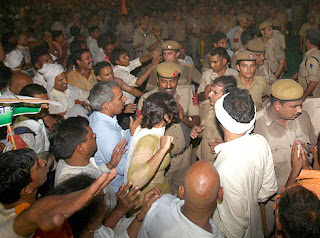
Just as senior government figures appeared on TV threatening "firm action", police appeared and started to disperse tens of thousands of demonstrators, many from rural areas or small towns, who had gathered under tents in the centre of the capital. Some of Ramdev's supporters threw stones at police.
Ramdev, who rose from a humble background to run a £20m empire of ashrams and alternative medicine, was arrested while trying to disguise himself in women's clothing, and was flown to the northern city of Haridwar, where he has his headquarters.

"You could not imagine a government handling it more clumsily," said Professor Jayati Ghosh, a respected Indian analyst and economist.
Ramdev, whose television channel draws audiences of up to 30 million and whose international network of ashrams includes one on a Scottish island, had begun fasting "unto death" on Saturday morning.
The incident is likely to further embarrass the ailing government of the prime minister, Manmohan Singh, and fuel broad public anger over a series of corruption scandals.

Corruption has long been a problem in India. Paying small bribes is a part of everyday life and senior ministers, bureaucrats, military officers and other officials are repeatedly found to have made vast sums illicitly.
The issue has become a focus of frustration with the current government, a coalition led by the Congress party. One recent scam may have cost the country as much as £25bn.
Leaders of India's main opposition party, the Bharatiya Janata, (BJP), attacked the Congress party and said the police action had been "a shameful chapter in the democracy of this country".
Ramdev criticised the Congress president, Italian-born Sonia Gandhi, saying she did not appear to love Indians, a charge frequently made by the rightwing in India.

Congress party figures alleged that Ramdev was linked to opposition parties including extremist Hindu nationalist groups.
Digvijay Singh, a senior Congress leader who had earlier questioned Ramdev's luxurious lifestyle and called his campaign a "five-star" protest, accused the guru of inciting people.
"You can't allow people like Ramdev to run riot in a capital like Delhi. Some laws, some rules have to be followed," Singh said. "And whereas he has taken permission for yogic shivir [camp], what was he doing there? He was trying to agitate people."
Political analysts claim the recent campaigns against corruption have in part gathered public support because they exist outside established politics. However, both Ramdev and Anna Hazare, a veteran social activist who launched a similar anti-corruption protest in April, hold deeply conservative views on a broad range of issues.
Ramdev dislikes Coca-Cola and western clothes, believes the World Health Organisation is a western conspiracy and is openly homophobic. Hazare is a strict teetotaller, believes in flogging and has banned tobacco, meat and cable TV in the village where he lives near the central city of Pune. Both men favour capital punishment for corruption crimes.
"Ramdev and Hazare are fundamentally very populist," said Ghosh. "They are authoritarian, with have a simplistic message and are extremely socially and politically conservative. They are presented as moral figures but are not."
Both men also contest the same political ground; one possible reason for the increasing intensity of their activism.
On Sunday Hazare pledged to fast again. So too did Ramdev, who plans to launch a political party to contest the 2014 general election.
"My hunger strike has not ended. I will continue fasting," Ramdev told a news conference.
The guru, who has made a fortune through alternative medicine, has called on the government to pursue billions of dollars in illegal funds abroad. Huge amounts of money have disappeared from India, one of the world's fastest-growing economies, in recent decades.
Ramdev has also called for a ban on notes of large denomination – 500 and 1,000 Indian rupees (£7 and £14) – which represent a huge amount of money for the hundreds of millions of people in India who survive on less than £1 a day.
Corruption is said to be present on such a vast scale in India that it threatens the continued economic success of the country, depressing the stock market and worrying investors.
Analysts are concerned that the latest examples of corruption will again stall key reforms aimed at boosting overseas investment and improving India's parlous infrastructure, many projects of which have repeatedly been postponed, in part due to opposition protests over corruption causing parliamentary deadlock.
Corruption in India
Recent high-profile Indian corruption scandals have included the 2G scam – named after the mobile telephone technology for which licences in India were allegedly sold off at cut-price rates in return for kickbacks – and allegations of fraud in preparations for the 2010 Commonwealth Games in Delhi. The 2G scam is thought to have cost the country up to £25bn. An investigation has resulted in the jailing of a former minister and the daughter of a southern Indian political leader. An inquiry into the 2010 Games is ongoing but has already led to the arrests of senior figures in the ruling Congress party.
Other scandals have included a luxury housing development built for widows of war heroes that was appropriated by politicians, senior officers and bureaucrats in the commercial capital of Mumbai, and revelations of corruption in state programmes to distribute subsidised food to the poor. In the northern state of Uttar Pradesh, where 200 million mainly poor people live, the extent of the corruption and the extent of the programme make it potentially the biggest single example of corruption in the world, with tens of thousands of officials, thousands of politicians and more than £30bn worth of aid implicated.
Few sectors are untouched. One recent scandal was less about cash than influence. A series of phone taps released to the media revealed corporate lobbyists apparently discussing cabinet appointments with ministers and journalists. There are regular scandals over "paid news" by which newspapers accept cash to run particular stories. Top bank officials have been accused of taking bribes to grant corporate loans. Many senior judges are alleged to be corrupt. An ex-chief justice is currently under investigation.
Indian police have used teargas and batons to break up a mass anti-corruption protest led by India's most famous yoga guru, in the latest high-profile clash between authorities and campaigners.

At least 30 people were injured, several seriously, in chaotic scenes in the capital, Delhi, after talks between the government and the saffron-robed guru Swami Ramdev to end the protest broke down.

Just as senior government figures appeared on TV threatening "firm action", police appeared and started to disperse tens of thousands of demonstrators, many from rural areas or small towns, who had gathered under tents in the centre of the capital. Some of Ramdev's supporters threw stones at police.
Ramdev, who rose from a humble background to run a £20m empire of ashrams and alternative medicine, was arrested while trying to disguise himself in women's clothing, and was flown to the northern city of Haridwar, where he has his headquarters.

"You could not imagine a government handling it more clumsily," said Professor Jayati Ghosh, a respected Indian analyst and economist.
Ramdev, whose television channel draws audiences of up to 30 million and whose international network of ashrams includes one on a Scottish island, had begun fasting "unto death" on Saturday morning.
The incident is likely to further embarrass the ailing government of the prime minister, Manmohan Singh, and fuel broad public anger over a series of corruption scandals.

Corruption has long been a problem in India. Paying small bribes is a part of everyday life and senior ministers, bureaucrats, military officers and other officials are repeatedly found to have made vast sums illicitly.
The issue has become a focus of frustration with the current government, a coalition led by the Congress party. One recent scam may have cost the country as much as £25bn.
Leaders of India's main opposition party, the Bharatiya Janata, (BJP), attacked the Congress party and said the police action had been "a shameful chapter in the democracy of this country".
Ramdev criticised the Congress president, Italian-born Sonia Gandhi, saying she did not appear to love Indians, a charge frequently made by the rightwing in India.

Congress party figures alleged that Ramdev was linked to opposition parties including extremist Hindu nationalist groups.
Digvijay Singh, a senior Congress leader who had earlier questioned Ramdev's luxurious lifestyle and called his campaign a "five-star" protest, accused the guru of inciting people.
"You can't allow people like Ramdev to run riot in a capital like Delhi. Some laws, some rules have to be followed," Singh said. "And whereas he has taken permission for yogic shivir [camp], what was he doing there? He was trying to agitate people."
Political analysts claim the recent campaigns against corruption have in part gathered public support because they exist outside established politics. However, both Ramdev and Anna Hazare, a veteran social activist who launched a similar anti-corruption protest in April, hold deeply conservative views on a broad range of issues.
Ramdev dislikes Coca-Cola and western clothes, believes the World Health Organisation is a western conspiracy and is openly homophobic. Hazare is a strict teetotaller, believes in flogging and has banned tobacco, meat and cable TV in the village where he lives near the central city of Pune. Both men favour capital punishment for corruption crimes.
"Ramdev and Hazare are fundamentally very populist," said Ghosh. "They are authoritarian, with have a simplistic message and are extremely socially and politically conservative. They are presented as moral figures but are not."
Both men also contest the same political ground; one possible reason for the increasing intensity of their activism.
On Sunday Hazare pledged to fast again. So too did Ramdev, who plans to launch a political party to contest the 2014 general election.
"My hunger strike has not ended. I will continue fasting," Ramdev told a news conference.
The guru, who has made a fortune through alternative medicine, has called on the government to pursue billions of dollars in illegal funds abroad. Huge amounts of money have disappeared from India, one of the world's fastest-growing economies, in recent decades.
Ramdev has also called for a ban on notes of large denomination – 500 and 1,000 Indian rupees (£7 and £14) – which represent a huge amount of money for the hundreds of millions of people in India who survive on less than £1 a day.
Corruption is said to be present on such a vast scale in India that it threatens the continued economic success of the country, depressing the stock market and worrying investors.
Analysts are concerned that the latest examples of corruption will again stall key reforms aimed at boosting overseas investment and improving India's parlous infrastructure, many projects of which have repeatedly been postponed, in part due to opposition protests over corruption causing parliamentary deadlock.
Corruption in India
Recent high-profile Indian corruption scandals have included the 2G scam – named after the mobile telephone technology for which licences in India were allegedly sold off at cut-price rates in return for kickbacks – and allegations of fraud in preparations for the 2010 Commonwealth Games in Delhi. The 2G scam is thought to have cost the country up to £25bn. An investigation has resulted in the jailing of a former minister and the daughter of a southern Indian political leader. An inquiry into the 2010 Games is ongoing but has already led to the arrests of senior figures in the ruling Congress party.
Other scandals have included a luxury housing development built for widows of war heroes that was appropriated by politicians, senior officers and bureaucrats in the commercial capital of Mumbai, and revelations of corruption in state programmes to distribute subsidised food to the poor. In the northern state of Uttar Pradesh, where 200 million mainly poor people live, the extent of the corruption and the extent of the programme make it potentially the biggest single example of corruption in the world, with tens of thousands of officials, thousands of politicians and more than £30bn worth of aid implicated.
Few sectors are untouched. One recent scandal was less about cash than influence. A series of phone taps released to the media revealed corporate lobbyists apparently discussing cabinet appointments with ministers and journalists. There are regular scandals over "paid news" by which newspapers accept cash to run particular stories. Top bank officials have been accused of taking bribes to grant corporate loans. Many senior judges are alleged to be corrupt. An ex-chief justice is currently under investigation.
2G Spectrum Scam - Raja-Radia Tapes
The Raja-Radia Tapes
Four transcripts that were submitted to the SC along with a total of eight recordings in May 2009 covering the cabinet formation, DMK politics and who'd get telecom portfolio

We have not edited or changed the style or spellings used in the transcripts submitted to court. Please allow a few seconds to elapse before the recordings begin.
Audio Files:
06-188819-0-03-20090522-014237
11-188819-0-31-20090524-110511
28-188819-0-19-20090522-132029
A Raja50-188819-0-27-20090523-142941
A Raja-06-188819-0-03-20090522-014237
A Raja-28-188819-0-19-20090522-132029
A Raja--11-188819-0-31-20090524-110511
Transcripts
22 May 2009, 09:48:51
Nira: Hello?
Raja: Raja here
Nira: Hi! I got a message from Barkha Dutt just now
Raja: Huh?
Nira: Barkha Dutt
Raja: What does she say?
Nira: She says… that she has been following up the story with Prime Minister’s Office tonight. In fact, she was the one who told me that Sonia Gandhi went there. She says that he has no problem with you, but he has a problem with Baalu
Raja: …but it has to be discussed with Leader
Nira: yeah, yeah… he has to discuss with the Leader. He has to tell…
Raja: It will be discussed in the morning… why unnecessarily Congress… [indiscernible] tie-up is going out
Nira: No, but then the question is about Azhagiri, no?
Raja: Huh?
Nira: Azhagiri’s people are saying: why is Maran getting Cabinet when he is such a senior leader himself?
Raja: That is different, but all these things must be explored and disclosed
Nira: That’s right. That’s right. I told her to get Congress…
Raja: At least, one to one, let it be disclosed to Leader
Nira: One to one?
Raja: One to one. Somebody should give a message, at least in a sealed cover, that we are having serious problems to Baalu
Nira: From Congress, right?
R: Yes
N: Okay, I’ll tell her. She is talking to Ahmed Patel, so I will talk to him
Raja: Let him [sic] call at least over phone: Sir, this is problem… we are having high regard, we are having no problem with Raja, but problem is Baalu. Tell.
Nira: Then how will you resolve the other problem?
Raja: Other problems we will take care of slowly, because now Leader comes down
Nira: Uh huh.
R: Don’t worry
N: Now Leader comes down to three, no?
Raja: Comes down for [sic] three…
Nira: Yeah
Raja: Even you are saying that Maran is not fit for infrastructure… he is having controversy… alright, let him be accommodated in the existing ministry… at least we will suggest
Nira: Maran?
Raja: Hmm… you suggest, you send a message
Nira: Uh, huh
Raja: Okay
Nira: Okay
***
May 22, 2009, 13:20:29
NIRA calling RAJA. Put on hold
RAJA: Tell me, Nira
NIRA: The thing is that the Congress has been totally confused as to who they need to speak to.
RAJA: Huh?
NIRA: Who they need to speak to in the DMK
RAJA: Ah… somebody should fly to Leader
NIRA: No, no… That is why, I am now… they’re going to speak to Kani in a little while, and then Kani is going to take them to Leader directly, and let Kani…
RAJA: That is good, that is good.
NIRA: Yeah? I have done… just told them that, because they’re completely confused who to talk to. Yeah?
RAJA: Let them talk to Kani
NIRA: Yeah, but Kani should also be sensible enough to say that she does not want anything for herself. No? I have told her that…
RAJA: Hmm
NIRA: …but you also make sure.
RAJA: No problem
NIRA: I told them. I told them that whatever…
RAJA: See, tell Kani: let her call Leader, (tell him) this is the problem, shall I bring the people?
NIRA: Yeah, because what they’re saying is that they will not give infrastructure to Baalu and Maran. They should say that to Leader directly, no?
RAJA: No problem. Look See… let them go along with Kani, and let them tell that we are having problem with these fellows
RAJA: That’s right. That’s what they have to do… they were confused… what happened is: for the UPA meeting, Maran went along… so they think Maran is the interlocutor, he is the person who’s going to talk, so there is this…
RAJA: Not at all. He came for assistance, that’s all
NIRA: No. I know, but you see this is a wrong message that has gone out, and they don’t know
[AUDIO ENDS]
May 23, 2009, 14:29:41
NIRA: Raja how are you?
RAJA: Haan, What she is telling, Kani is telling?
NIRA: She’s telling that she’s okay about it. She has no problem…
RAJA: Hmm
NIRA: …but the only thing is that somebody has to go talk to Azhagiri, which you have to do.
RAJA: Hmm
NIRA: And tell him how Maranhas gone and told…
RAJA: Haan, I already spoke with him, I already spoke with him…
NIRA: You told him what he has told the Congress leaders in Delhi?
RAJA: I know. So who planted in the minds of the Congress saying that Azhagiri doesn’t know English… I know…
NIRA: No, no, no, no…. Not only that. Not only that. That he and Stalin tomorrow will be the only ones left to run the party because the old man is senile and he is not going to be around any longer, and therefore Congress will be happy doing business with him because it will be him… him eventually, and he controls Stalin.
RAJA: Hmm…
NIRA: This is what he has said.
RAJA: Oh, ho, ho, ho!
NIRA: And that Azhagiri is criminal…
RAJA: Hmm…
NIRA: And he has not even studied more than 5th standard.
RAJA: Oh…
NIRA: That’s the exact thing that he has told.
RAJA: Okay, okay
NIRA: You go and tell him this, no?
RAJA: No I shared with Azhagiri…Azhagiri in turn went to speak with Leader.
NIRA: No, but he has also said this… that in Delhi, I am the only one that you have to deal with eventually because, any case, Stalin will remain in the State
RAJA: I know, see, I know what type of propaganda he will manage…
***
May 24, 2009, 11:05:11
Nira: Hi!
Raja: Hello?
Nira: Hi!
Raja: Tell me.
Nira: Mr Raja?
Raja: Yes?
Nira: Nira
Raja: Tell me, Nira, anything?
Nira: I sent you an SMS. I’ve been speaking to Kani, so I just thought that… basically what they are saying is that you should be there.
Raja: Haan
Nira: Leader is generally is saying that you should be there, because of the, you know, the Dalit dispensation, all that, you know. The Dravidian, the party, and all that… saying that Leader, if it was left to him, he would have focused on the party first. This is unfortunate that his family is coming in the way and Cho Ramaswamy has given a favourable remark that it should be limited to this thing
Raja: Okay
Nira: But I’ve been talking to Kani, she spoke to me, she said, “No independent.” They are not giving independent… just now.
Raja: My case is clear, yes?
Nira: Yours is clear, yeah. Your case was cleared last night only
Raja: Okay
Nira: No, but what is happening with Daya?
Raja: What?
Nira: Daya?
Raja: Rest of the thing is… Textiles or Fertilisers
Nira: Not for Daya…
Raja: Either of them.
Nira: But Azhagiri or Daya? Only one can come, no?
Raja: No, two. Two can come.
Nira: Both?
Raju: Baalu will be the problem. I hope [sic]
Nira: I think that will be difficult for the Leader to justify three family members.
Raja: That is it, that is… (chuckles) everybody knows
Nira: No, no, she said that. Kani told me this last night, that’s what the father told her yesterday.
R: Oh
N: That for him to justify three family members will become very difficult. He recognises that problem.
Raja: What can you do? We’ll see, let us wait.
Nira: Yeah. I think he will have to relook at that. You’re all meeting him individually now? Or the meeting is still going on?
Raja: Not at all, not at all.
Nira: Narayanan’s meeting is going on?
Raja: Narayanan’s meeting is over. He has gone to Delhi, with cover.
Nira: He’s gone to?
Raja: He has gone to catch the flight… with cover.
Nira: Narayanan, yeah?
Raja: List, list…with the list, he has gone out.
Nira: He has gone out with the list, no?
Raja: I didn't know what is inside the cover.
Nira: And Kani? Is with father?
Raja: Maybe yes… maybe she knows.
Nira: I will call her now. And you are not there?
Raja: I am not yet there.
Nira: You’re not there? And Maran? Maran is there, no?
Raja: (He is) there, yes
Nira: Why you didn’t go?
Raja: I didn’t go.
Nira: Huh?
Raja: Alright… why should we go?
Nira: You should be there, no?
Raja: No problem… morning I met, and thereafter I came back for another work
Nira: And Azhagiri… he knows what Maran has been saying about him?
Raja: …it is known to Azhagiri.
Nira: It is, no?
Raja: It is known to Azhagiri, but he cannot talk with father… timely (sic) he will speak, only thing is, Maran will start the campaign against me…
N: Hmm
R: …that has to be taken care of
Nira: You have to fight differently.
R: Hmm… he may tell the press Prime Minister is coming again... this and that… spectrum…
Nira: No, no… we are handling… don’t worry. We have to take so much off, you know, even Congress had to make that statement, no? I spoke to Sunil Mittal…Did Chandoliya tell you?
Raja: I didn't know
Nira: I told him to stop. I told him, it doesn’t help…
Raja: Hmm …tell Sunil Mittal, you have to work along with Raja for another five years. So, don’t …
Nira: I told him that. I told him that. But then you also have to distance yourself from Anil. You must be neutral.
Raja: Ah that we can keep.
Audio Files:
06-188819-0-03-20090522-014237
11-188819-0-31-20090524-110511
28-188819-0-19-20090522-132029
A Raja50-188819-0-27-20090523-142941
A Raja-06-188819-0-03-20090522-014237
A Raja-28-188819-0-19-20090522-132029
A Raja--11-188819-0-31-20090524-110511
Four transcripts that were submitted to the SC along with a total of eight recordings in May 2009 covering the cabinet formation, DMK politics and who'd get telecom portfolio

We have not edited or changed the style or spellings used in the transcripts submitted to court. Please allow a few seconds to elapse before the recordings begin.
Audio Files:
06-188819-0-03-20090522-014237
11-188819-0-31-20090524-110511
28-188819-0-19-20090522-132029
A Raja50-188819-0-27-20090523-142941
A Raja-06-188819-0-03-20090522-014237
A Raja-28-188819-0-19-20090522-132029
A Raja--11-188819-0-31-20090524-110511
Transcripts
22 May 2009, 09:48:51
Nira: Hello?
Raja: Raja here
Nira: Hi! I got a message from Barkha Dutt just now
Raja: Huh?
Nira: Barkha Dutt
Raja: What does she say?
Nira: She says… that she has been following up the story with Prime Minister’s Office tonight. In fact, she was the one who told me that Sonia Gandhi went there. She says that he has no problem with you, but he has a problem with Baalu
Raja: …but it has to be discussed with Leader
Nira: yeah, yeah… he has to discuss with the Leader. He has to tell…
Raja: It will be discussed in the morning… why unnecessarily Congress… [indiscernible] tie-up is going out
Nira: No, but then the question is about Azhagiri, no?
Raja: Huh?
Nira: Azhagiri’s people are saying: why is Maran getting Cabinet when he is such a senior leader himself?
Raja: That is different, but all these things must be explored and disclosed
Nira: That’s right. That’s right. I told her to get Congress…
Raja: At least, one to one, let it be disclosed to Leader
Nira: One to one?
Raja: One to one. Somebody should give a message, at least in a sealed cover, that we are having serious problems to Baalu
Nira: From Congress, right?
R: Yes
N: Okay, I’ll tell her. She is talking to Ahmed Patel, so I will talk to him
Raja: Let him [sic] call at least over phone: Sir, this is problem… we are having high regard, we are having no problem with Raja, but problem is Baalu. Tell.
Nira: Then how will you resolve the other problem?
Raja: Other problems we will take care of slowly, because now Leader comes down
Nira: Uh huh.
R: Don’t worry
N: Now Leader comes down to three, no?
Raja: Comes down for [sic] three…
Nira: Yeah
Raja: Even you are saying that Maran is not fit for infrastructure… he is having controversy… alright, let him be accommodated in the existing ministry… at least we will suggest
Nira: Maran?
Raja: Hmm… you suggest, you send a message
Nira: Uh, huh
Raja: Okay
Nira: Okay
***
May 22, 2009, 13:20:29
NIRA calling RAJA. Put on hold
RAJA: Tell me, Nira
NIRA: The thing is that the Congress has been totally confused as to who they need to speak to.
RAJA: Huh?
NIRA: Who they need to speak to in the DMK
RAJA: Ah… somebody should fly to Leader
NIRA: No, no… That is why, I am now… they’re going to speak to Kani in a little while, and then Kani is going to take them to Leader directly, and let Kani…
RAJA: That is good, that is good.
NIRA: Yeah? I have done… just told them that, because they’re completely confused who to talk to. Yeah?
RAJA: Let them talk to Kani
NIRA: Yeah, but Kani should also be sensible enough to say that she does not want anything for herself. No? I have told her that…
RAJA: Hmm
NIRA: …but you also make sure.
RAJA: No problem
NIRA: I told them. I told them that whatever…
RAJA: See, tell Kani: let her call Leader, (tell him) this is the problem, shall I bring the people?
NIRA: Yeah, because what they’re saying is that they will not give infrastructure to Baalu and Maran. They should say that to Leader directly, no?
RAJA: No problem. Look See… let them go along with Kani, and let them tell that we are having problem with these fellows
RAJA: That’s right. That’s what they have to do… they were confused… what happened is: for the UPA meeting, Maran went along… so they think Maran is the interlocutor, he is the person who’s going to talk, so there is this…
RAJA: Not at all. He came for assistance, that’s all
NIRA: No. I know, but you see this is a wrong message that has gone out, and they don’t know
[AUDIO ENDS]
May 23, 2009, 14:29:41
NIRA: Raja how are you?
RAJA: Haan, What she is telling, Kani is telling?
NIRA: She’s telling that she’s okay about it. She has no problem…
RAJA: Hmm
NIRA: …but the only thing is that somebody has to go talk to Azhagiri, which you have to do.
RAJA: Hmm
NIRA: And tell him how Maranhas gone and told…
RAJA: Haan, I already spoke with him, I already spoke with him…
NIRA: You told him what he has told the Congress leaders in Delhi?
RAJA: I know. So who planted in the minds of the Congress saying that Azhagiri doesn’t know English… I know…
NIRA: No, no, no, no…. Not only that. Not only that. That he and Stalin tomorrow will be the only ones left to run the party because the old man is senile and he is not going to be around any longer, and therefore Congress will be happy doing business with him because it will be him… him eventually, and he controls Stalin.
RAJA: Hmm…
NIRA: This is what he has said.
RAJA: Oh, ho, ho, ho!
NIRA: And that Azhagiri is criminal…
RAJA: Hmm…
NIRA: And he has not even studied more than 5th standard.
RAJA: Oh…
NIRA: That’s the exact thing that he has told.
RAJA: Okay, okay
NIRA: You go and tell him this, no?
RAJA: No I shared with Azhagiri…Azhagiri in turn went to speak with Leader.
NIRA: No, but he has also said this… that in Delhi, I am the only one that you have to deal with eventually because, any case, Stalin will remain in the State
RAJA: I know, see, I know what type of propaganda he will manage…
***
May 24, 2009, 11:05:11
Nira: Hi!
Raja: Hello?
Nira: Hi!
Raja: Tell me.
Nira: Mr Raja?
Raja: Yes?
Nira: Nira
Raja: Tell me, Nira, anything?
Nira: I sent you an SMS. I’ve been speaking to Kani, so I just thought that… basically what they are saying is that you should be there.
Raja: Haan
Nira: Leader is generally is saying that you should be there, because of the, you know, the Dalit dispensation, all that, you know. The Dravidian, the party, and all that… saying that Leader, if it was left to him, he would have focused on the party first. This is unfortunate that his family is coming in the way and Cho Ramaswamy has given a favourable remark that it should be limited to this thing
Raja: Okay
Nira: But I’ve been talking to Kani, she spoke to me, she said, “No independent.” They are not giving independent… just now.
Raja: My case is clear, yes?
Nira: Yours is clear, yeah. Your case was cleared last night only
Raja: Okay
Nira: No, but what is happening with Daya?
Raja: What?
Nira: Daya?
Raja: Rest of the thing is… Textiles or Fertilisers
Nira: Not for Daya…
Raja: Either of them.
Nira: But Azhagiri or Daya? Only one can come, no?
Raja: No, two. Two can come.
Nira: Both?
Raju: Baalu will be the problem. I hope [sic]
Nira: I think that will be difficult for the Leader to justify three family members.
Raja: That is it, that is… (chuckles) everybody knows
Nira: No, no, she said that. Kani told me this last night, that’s what the father told her yesterday.
R: Oh
N: That for him to justify three family members will become very difficult. He recognises that problem.
Raja: What can you do? We’ll see, let us wait.
Nira: Yeah. I think he will have to relook at that. You’re all meeting him individually now? Or the meeting is still going on?
Raja: Not at all, not at all.
Nira: Narayanan’s meeting is going on?
Raja: Narayanan’s meeting is over. He has gone to Delhi, with cover.
Nira: He’s gone to?
Raja: He has gone to catch the flight… with cover.
Nira: Narayanan, yeah?
Raja: List, list…with the list, he has gone out.
Nira: He has gone out with the list, no?
Raja: I didn't know what is inside the cover.
Nira: And Kani? Is with father?
Raja: Maybe yes… maybe she knows.
Nira: I will call her now. And you are not there?
Raja: I am not yet there.
Nira: You’re not there? And Maran? Maran is there, no?
Raja: (He is) there, yes
Nira: Why you didn’t go?
Raja: I didn’t go.
Nira: Huh?
Raja: Alright… why should we go?
Nira: You should be there, no?
Raja: No problem… morning I met, and thereafter I came back for another work
Nira: And Azhagiri… he knows what Maran has been saying about him?
Raja: …it is known to Azhagiri.
Nira: It is, no?
Raja: It is known to Azhagiri, but he cannot talk with father… timely (sic) he will speak, only thing is, Maran will start the campaign against me…
N: Hmm
R: …that has to be taken care of
Nira: You have to fight differently.
R: Hmm… he may tell the press Prime Minister is coming again... this and that… spectrum…
Nira: No, no… we are handling… don’t worry. We have to take so much off, you know, even Congress had to make that statement, no? I spoke to Sunil Mittal…Did Chandoliya tell you?
Raja: I didn't know
Nira: I told him to stop. I told him, it doesn’t help…
Raja: Hmm …tell Sunil Mittal, you have to work along with Raja for another five years. So, don’t …
Nira: I told him that. I told him that. But then you also have to distance yourself from Anil. You must be neutral.
Raja: Ah that we can keep.
Audio Files:
06-188819-0-03-20090522-014237
11-188819-0-31-20090524-110511
28-188819-0-19-20090522-132029
A Raja50-188819-0-27-20090523-142941
A Raja-06-188819-0-03-20090522-014237
A Raja-28-188819-0-19-20090522-132029
A Raja--11-188819-0-31-20090524-110511
Subscribe to:
Posts (Atom)
-
 Different types of bra Welcome to this post, we are here to help you with the different types of bras out there and help you make the ...
 -
 Mens Fashion Wear Hugo Boss is one of the leading designers of high-end menswear in the world today, but the company has a checkered ...
 -
Tirukkuraḷ Tirukkuṛaḷ ( Tamil : திருக்குறள் also known as the Kural ), sometimes spelt 'Thirukkural, is a classic of couplets or Kur...