More People killed, hundreds of houses destroyed in Pakistan
A powerful earthquake in Iran
on Tuesday hit hundreds of homes in Pakistan, killing more than 30
people in a remote community close to the desert border, officials said.
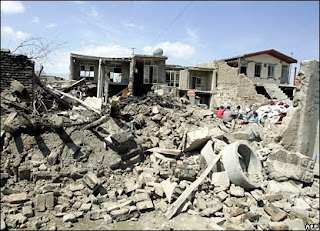
The quake damaged mud houses in the town of Mashkail in Pakistan's Baluchistan province, state broadcaster PTV reported.
Two military helicopters carrying medical teams have been sent to the
area, which lies just a few kilometres from the frontier, while
paramiltary troops were being moved to supplement the relief efforts.
"At least 34 people have been killed and 80 others wounded in Mashkail," a local government official told AFP.
"The bodies are at the hospital and injured are being treated by army doctors. Paramilitary forces are busy in rescue work."
Tremors cracked government buildings in the area and PTV said President Asif Ali Zardari had expressed grief over the losses in Iran and Pakistan.
Iran's Seismological Centre said that the 7.5-magnitude quake struck at
3:14 pm (1044 GMT) in the country's southeast, close to the border with
Pakistan and Afghanistan. The website of the US Geological Survey put
the magnitude of the quake at 7.8.
Local hospital official Ashraf Baloch told AFP by telephone from Mashkail that several hundred houses had been damaged.
"The Washuk has been destroyed and also hundreds of houses have been damaged in surrounding villages," Baloch told AFP.
Mehdi Zare, an official at the Seismological Centre, told state television that the earthquake was unprecedented in 56 years.
In December 2003, a 6.6-magnitude quake killed 31,000 people in Iran's
southern city of Bam and destroyed its ancient, mud-built citadel.
Tuesday's earthquake was felt across large parts of Pakistan including
Islamabad, where buildings shook, and the largest city Karachi where
tremors prompted many to flee buildings in terror.
There were no reports of significant damage to infrastructure.
Pakistan's Jamaat-ud-Dawa charity, one of Pakistan's biggest charities
but on a UN terror blacklist as an alleged front for terror group
Lashkar-e-Taiba, announced on Twitter that its teams were already in
place.
"Rescue and Aid Teams have reached Kharan and Panjgour
while relief efforts are underway now in these districts," it wrote on
its official account.
Hafiz Muhammad Saeed,
the head of JuD and the founder of Lashkar-e-Taiba, also tweeted in
English: "Our thought, prayers go out to the victims of earthquake in
Iran affected areas in Pakistan. Our Rescue & aid Teams have reached
at site."
Pakistan was hit by a 7.6-magnitude earthquake on
October 8, 2005, that killed more than 73,000 people and left about 3.5
million homeless, mainly in Pakistan-controlled Kashmir and parts of
northwestern Khyber Pakhtunkhwa.
Showing posts with label Earthquake. Show all posts
Showing posts with label Earthquake. Show all posts
Tuesday, 16 April 2013

Earthquake 7.8 magnitude quake strikes Iran, felt in Pakistan, India and other gulf nations
According to the USGS, the quake measured 7.8 on the Richter scale.
A major 7.8 magnitude earthquake struck Iran near the border with Pakistan on Tuesday killing 40 people and injuring many.
An Iranian government official said on Tuesday he expected hundreds of deaths.
"It was the biggest earthquake in Iran in 40 years and we are expecting hundreds of dead," said the official, who spoke on condition of anonymity.
The tremors were also felt in Pakistan, India and other gulf nations.
13 people were killed in southwestern Pakistan on when the region was struck by tremors from the earthquake.
The three women and two children were killed when their mud house collapsed in the district of Panjgur in the Pakistani province of Baluchistan, according to government officials from the area.
The US Geological Survey said the quake hit at 10:44 GMT at a depth of 15.2 km (9.4 miles). The epicentre was in southeast Iran in an area of mountains and desert.
It was located 201 km (125 miles) southeast of the Iranian city of Zahedan and 250 km northwest of Turbat in Pakistan, USGS said.
The epicentre of the quake was 86 km from the city of Khash, near Pakistan's border.
Tremors were felt in the capital and its adjoining areas Tuesday afternoon.
Many people rushed out of their offices and homes in the National Capital Region after the quake that lasted several seconds.
According to the USGS, the quake measured 8 on the Richter scale.
A powerful 6.3 magnitude quake struck close to Iran's only nuclear power station on April 9, killing 37 people and injuring 850 as it destroyed homes and devastated two villages.
Tremors felt in India too
Strong tremors rocked large parts of north India, including the national capital and its adjoining areas, Tuesday evening. There were no immediate reports of any casualties. The quake measured 7.8 on the Richter scale at its epicentre on the Pakistan-Iran border.
"The epicentre of the quake was the Pakistan-Iran border and it measured 7.8 on the Richter scale," V. Dattatreya, head, seismology, India Meteorological Department (IMD), told IANS.
The quake took place at 4.14 p.m. (IST) at a depth of 33 km, an official said.
The strong tremors that lasted several seconds, leading to panic in many places. People rushed out of their offices and homes in the National Capital Region.
Friday, 6 May 2011
Earthquake
Earthquake

An earthquake (also known as a quake, tremor or temblor) is the result of a sudden release of energy in the Earth's crust that creates seismic waves. The seismicity or seismic activity of an area refers to the frequency, type and size of earthquakes experienced over a period of time. Earthquakes are measured using observations from seismometers. The moment magnitude is the most common scale on which earthquakes larger than approximately 5 are reported for the entire globe.
The more numerous earthquakes smaller than magnitude 5 reported by national seismological observatories are measured mostly on the local magnitude scale, also referred to as the Richter scale. These two scales are numerically similar over their range of validity. Magnitude 3 or lower earthquakes are mostly almost imperceptible and magnitude 7 and over potentially cause serious damage over large areas, depending on their depth. The largest earthquakes in historic times have been of magnitude slightly over 9, although there is no limit to the possible magnitude.

The most recent large earthquake of magnitude 9.0 or larger was a 9.0 magnitude earthquake in Japan in 2011 (as of March 2011), and it was the largest Japanese earthquake since records began. Intensity of shaking is measured on the modified Mercalli scale. The shallower an earthquake, the more damage to structures it causes, all else being equal.
Release of energy waves called seismic waves in the crust of earth, leads to the creation of a natural disaster called earthquake. Earthquakes can be recorded using an instrument called as seismometer. Richter scale is used to represent magnitude and intensity of earthquakes. Those earthquakes which show reading of 3 on Richter scale are usually not harmful as such, but earthquakes which show reading of 7 or more are extremely harmful. So, more the scale of reading more harmful is the earthquake.
The origin point of seismic waves is called epicenter of earthquake. If epicenter is located near the sea then it can cause the creation of Tsunami waves. Earthquakes lead to severe shaking of earth’s surface, landslides etc. Earthquakes are generally results of natural phenomena like geological stress, volcanic eruptions, landslides etc but earthquakes can also be induced by some human activities like mine blasts and nuclear experimentation etc. the first rupture point of earthquake is called focus hypocenter and epicenter is the point at ground level exactly above the hypocenter.

Naturally occurring earthquakes and earthquake storms
Those earthquakes which occur due to some natural phenomena are generally more intensified and harmful. These Tectonic earthquakes can occur just anywhere in earth where enough elastic strain energy is stored to conduct fracture propagation at a fault plane. There are basically 3 types of faults, which cause creation of the earthquakes- reverse, strike-slip and normal. Reason of a certain displacement decides the intensity of the earthquakes. Earthquakes are classified as extreme destruction source of nature because an exact warning can’t be extracted about earthquakes. Even sometimes earthquakes can hit a region in a series. In this situation one new earthquake gets triggered due to displacement, shaking or stress induction by previous strike of earthquake. This situation is called earthquake storm. This is extremely detrimental for human life and property.
Impacts of earthquakes
Impacts of earthquakes can be classified into various classes-
Ground rupture- It is the main result of an earthquake strike. Shaking of ground causes severe damage to the buildings or other structures on the ground including houses etc. Shaking of ground at a particular place depends upon the distance of that place from the epicenter. Severe shaking of ground causes destruction of all the buildings of a city and many people die by burring into the building materials.
It can’t be avoided because earthquakes strike a place all of a sudden. So this shaking of ground compels construction engineering to develop buildings which are resistive to the strikes of earthquakes. The branch of engineering deals which deals with anti-earthquake construction is called Earthquake construction.
Landslides- Earthquakes causes instability of land results into landslides; this claims many lives at the effected zone.
Fire- Earthquake causes breaking of electrical power lines or gas supply lines which causes incidents of fires. Water lines also got ruptured and decreased pressure makes it impossible to control the spread of fire. In earthquake of San Francisco in 1906, more deaths happened because of fire as compared to earthquake itself.
Soil liquefaction- When severe shaking occur then soil or sand loses their strength for a temporary period and gets converted from solid to liquid. This liquefaction causes sinking of buildings, bridges etc.
Tsunami and floods- when epicenter of an earthquake is located near sea, then the traveling of seismic waves below the sea causes generation of Tsunami waves, which can travel at a speed of 600-800 kilometers per hour. For creation of Tsunami earthquakes are needed to be highly intensified. In general earthquakes havingreading of less then 7.5 on the Richter scale are not able to generate Tsunami waves. But stronger earthquakes can are comfortable enough to create Tsunamis. Sometimes when earthquake triggered landslides fall into sea, it leads to the creation of Tsunami waves.
Earthquake Construction
It is defined as the branch of the modern architectural engineering, having major concern of making structures which can withstand a severe earthquake shock. This branch of engineering is earning major concerns by countries like Japan, Chine, Turkey, Algeria and other countries near boundaries of tectonic plates. Because these areas of world are much more susceptible to strikes of earthquakes and major steps are necessary to avoid the destruction of human life and infrastructure.
Earthquakes Construction Techniques
Japan is first country of world to develop special techniques of earthquake construction, but now a days these techniques are common in other countries also. These days a construction is believed to be incomplete if it’s not properly entitled with earthquake precautions. In earlier days we were not available with modern facilities of engineering and technology. So during those times engineers construct a structure with a hope and wait for the strike of earthquake to test their precautionary measures of construction. But these days we are now available with the shake-tables, affixed with large motor utilities and computer monitoring techniques. This helps us to develop precise models which can be named as anti-earthquake construction models. Modern construction materials like reinforced concrete and concrete can also help but a special set of guidelines is necessary to do a construction with these flexible materials.
It has been observed that these materials are not comfortable to withstand with lateral forces or stresses caused by earthquakes. So steel reinforcing bar called rebar should also be used in constructions. All the joints i.e. where columns meet with the beams should be carefully tied using rebar. Brick infill should be avoided. Concrete of good quality should be used in a construction and anchor bolts should be used for providing strength to the construction. In spite of construction guidelines different countries issue a different set of rule book for the construction in that particular country. This rule book is according to distance of the country from the boundaries of tectonic plates. These rule books restrict construction in that zones which are very much prone to the earthquake strikes.
Moreover a residential structure must be attached to the foundation of the structure by means of the bolts to restrict the sliding of the main foundation during shakings. As earthquake engineering is developing day by day, more prominent structures are available to the human populations which are safe and efficient in severe earthquake strikes. Research in the field is still going on to develop 100 % efficient guidelines for anti-earthquake constructions.

An earthquake (also known as a quake, tremor or temblor) is the result of a sudden release of energy in the Earth's crust that creates seismic waves. The seismicity or seismic activity of an area refers to the frequency, type and size of earthquakes experienced over a period of time. Earthquakes are measured using observations from seismometers. The moment magnitude is the most common scale on which earthquakes larger than approximately 5 are reported for the entire globe.
The more numerous earthquakes smaller than magnitude 5 reported by national seismological observatories are measured mostly on the local magnitude scale, also referred to as the Richter scale. These two scales are numerically similar over their range of validity. Magnitude 3 or lower earthquakes are mostly almost imperceptible and magnitude 7 and over potentially cause serious damage over large areas, depending on their depth. The largest earthquakes in historic times have been of magnitude slightly over 9, although there is no limit to the possible magnitude.

The most recent large earthquake of magnitude 9.0 or larger was a 9.0 magnitude earthquake in Japan in 2011 (as of March 2011), and it was the largest Japanese earthquake since records began. Intensity of shaking is measured on the modified Mercalli scale. The shallower an earthquake, the more damage to structures it causes, all else being equal.
Release of energy waves called seismic waves in the crust of earth, leads to the creation of a natural disaster called earthquake. Earthquakes can be recorded using an instrument called as seismometer. Richter scale is used to represent magnitude and intensity of earthquakes. Those earthquakes which show reading of 3 on Richter scale are usually not harmful as such, but earthquakes which show reading of 7 or more are extremely harmful. So, more the scale of reading more harmful is the earthquake.
The origin point of seismic waves is called epicenter of earthquake. If epicenter is located near the sea then it can cause the creation of Tsunami waves. Earthquakes lead to severe shaking of earth’s surface, landslides etc. Earthquakes are generally results of natural phenomena like geological stress, volcanic eruptions, landslides etc but earthquakes can also be induced by some human activities like mine blasts and nuclear experimentation etc. the first rupture point of earthquake is called focus hypocenter and epicenter is the point at ground level exactly above the hypocenter.


Naturally occurring earthquakes and earthquake storms
Those earthquakes which occur due to some natural phenomena are generally more intensified and harmful. These Tectonic earthquakes can occur just anywhere in earth where enough elastic strain energy is stored to conduct fracture propagation at a fault plane. There are basically 3 types of faults, which cause creation of the earthquakes- reverse, strike-slip and normal. Reason of a certain displacement decides the intensity of the earthquakes. Earthquakes are classified as extreme destruction source of nature because an exact warning can’t be extracted about earthquakes. Even sometimes earthquakes can hit a region in a series. In this situation one new earthquake gets triggered due to displacement, shaking or stress induction by previous strike of earthquake. This situation is called earthquake storm. This is extremely detrimental for human life and property.
Impacts of earthquakes
Impacts of earthquakes can be classified into various classes-
Ground rupture- It is the main result of an earthquake strike. Shaking of ground causes severe damage to the buildings or other structures on the ground including houses etc. Shaking of ground at a particular place depends upon the distance of that place from the epicenter. Severe shaking of ground causes destruction of all the buildings of a city and many people die by burring into the building materials.
It can’t be avoided because earthquakes strike a place all of a sudden. So this shaking of ground compels construction engineering to develop buildings which are resistive to the strikes of earthquakes. The branch of engineering deals which deals with anti-earthquake construction is called Earthquake construction.
Landslides- Earthquakes causes instability of land results into landslides; this claims many lives at the effected zone.
Fire- Earthquake causes breaking of electrical power lines or gas supply lines which causes incidents of fires. Water lines also got ruptured and decreased pressure makes it impossible to control the spread of fire. In earthquake of San Francisco in 1906, more deaths happened because of fire as compared to earthquake itself.
Soil liquefaction- When severe shaking occur then soil or sand loses their strength for a temporary period and gets converted from solid to liquid. This liquefaction causes sinking of buildings, bridges etc.
Tsunami and floods- when epicenter of an earthquake is located near sea, then the traveling of seismic waves below the sea causes generation of Tsunami waves, which can travel at a speed of 600-800 kilometers per hour. For creation of Tsunami earthquakes are needed to be highly intensified. In general earthquakes havingreading of less then 7.5 on the Richter scale are not able to generate Tsunami waves. But stronger earthquakes can are comfortable enough to create Tsunamis. Sometimes when earthquake triggered landslides fall into sea, it leads to the creation of Tsunami waves.
Earthquake Construction
It is defined as the branch of the modern architectural engineering, having major concern of making structures which can withstand a severe earthquake shock. This branch of engineering is earning major concerns by countries like Japan, Chine, Turkey, Algeria and other countries near boundaries of tectonic plates. Because these areas of world are much more susceptible to strikes of earthquakes and major steps are necessary to avoid the destruction of human life and infrastructure.
Earthquakes Construction Techniques
Japan is first country of world to develop special techniques of earthquake construction, but now a days these techniques are common in other countries also. These days a construction is believed to be incomplete if it’s not properly entitled with earthquake precautions. In earlier days we were not available with modern facilities of engineering and technology. So during those times engineers construct a structure with a hope and wait for the strike of earthquake to test their precautionary measures of construction. But these days we are now available with the shake-tables, affixed with large motor utilities and computer monitoring techniques. This helps us to develop precise models which can be named as anti-earthquake construction models. Modern construction materials like reinforced concrete and concrete can also help but a special set of guidelines is necessary to do a construction with these flexible materials.
It has been observed that these materials are not comfortable to withstand with lateral forces or stresses caused by earthquakes. So steel reinforcing bar called rebar should also be used in constructions. All the joints i.e. where columns meet with the beams should be carefully tied using rebar. Brick infill should be avoided. Concrete of good quality should be used in a construction and anchor bolts should be used for providing strength to the construction. In spite of construction guidelines different countries issue a different set of rule book for the construction in that particular country. This rule book is according to distance of the country from the boundaries of tectonic plates. These rule books restrict construction in that zones which are very much prone to the earthquake strikes.
Moreover a residential structure must be attached to the foundation of the structure by means of the bolts to restrict the sliding of the main foundation during shakings. As earthquake engineering is developing day by day, more prominent structures are available to the human populations which are safe and efficient in severe earthquake strikes. Research in the field is still going on to develop 100 % efficient guidelines for anti-earthquake constructions.
Subscribe to:
Posts (Atom)
-
 Different types of bra Welcome to this post, we are here to help you with the different types of bras out there and help you make the ...
 -
 Mens Fashion Wear Hugo Boss is one of the leading designers of high-end menswear in the world today, but the company has a checkered ...
 -
Here is a nice summary list of all VMworld US 2018 Breakout session with the respective video playback & download URLs. Enjoy! Bra...