Children's Day Celebrating Jawaharlal Nehru's Birth Anniversary
In India, Children's Day is celebrated on 14 November, the birthday of the country's first Prime Minister Jawaharlal Nehru. Jawaharlal Nehru, who was fondly called Chacha Nehru (Uncle Nehru) or Chaffinch (Uncle) by the kids, emphasized the importance of giving loveand affection to children, whom he saw as the bright future of India. He wanted to enhance the progress of Indian youth for which he established education institutes like AIIMS, Indian Institute of Technology. It is well known that Jawaharlal Nehru admired 2 things, one of which is rose and the other was children. To give him tribute, India celebrates this festival 14 November, the day of his birthday.
Many functions are organized in schools, offices and other organizations. Most schools hold cultural performances on this day, run by the children themselves. Teachers also get involved, and may perform songs and dances for their students. On this day, the State and the Central Government also make it a point to showcase children's films as part of Film festivals organized in many parts of the country. All over the country, various cultural and social institutions conduct competitions for children. Children's Day is seen as a day for the kids to engage in fun. Children take part in many sports organized for them.
India 87th on corruption list – Will we ever improve?
Have you noticed how a bunch of ants surround a cube of sugar? Similarly, where there is big money involved – the corruption will most likely find its roots dug deep into the system. It is literally under every stone you turn. And, by now, most of us in India have learned to live with corruption as a part and parcel of our life.
In India, the tentacles of corruption are spread far and wide in all horizons of life and not just limited to government organizations. Recent instances of IPL scam and the Commonwealth Games fiasco underscores as to how a big moolah can attract corruption even in a Gentleman’s game.
Moreover, corruption is not just limited to India. It is a massive phenomena and a real cancer destroying the benefits of globalization in many poor countries.
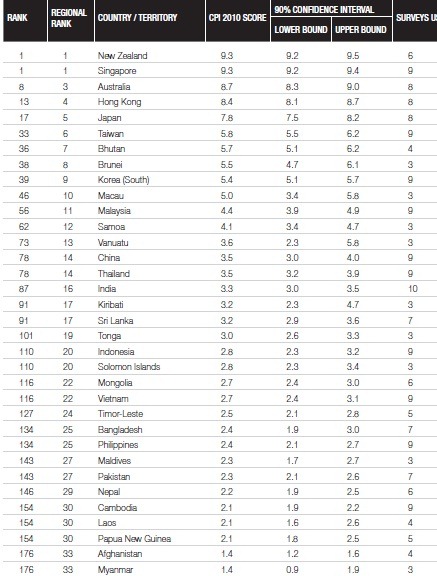
The 2010 Corruption Perceptions Indexshows that three quarters of the 178 countries in the index have fared miserably in terms of corruption problem. Specifically, India has slipped three places in global rankings of most corrupt countries, from 84 in 2009 to 87 this year.
On the ranking based on the scale from 0 (perceived to be highly corrupt) to 10 (low level of corruption), India scored 3.3 to grab 87th position in sharing with Jamaica and Liberia. It is understood that the CWG has to take blame for India’s poor show – on account of large-scale corruption in preparation to hosting the grand event.
On a positive note, only 5 countries – Denmark, New Zealand, Singapore, Finland and Sweden – managed to score higher than 9 points which indicates the list of least corrupted nations. The countries that ranked as most corrupt nations were Somalia, Myanmar, Afghanistan and Iraq.
Top Corrupt Countries in Asia
(1 being least corrupt)
The report released by Transparency International, which is based on input from 13 different experts and business surveys, further indicates that the global financial crisis took a toll on people’s views of corruption in government.
Notable among decliners over the past one year are some of the countries most affected by the financial crisis precipitated by transparency and integrity deficits. The survey highlighted the fact that few of the improvers were from the Organization for Economic Cooperation and Development (OECD).
This is the season of scams and the biggest ever corruption cases in India have been unearthed more recently. So, we decided to dig deep to see which scams were the biggest and most damaging to the country and its citizens alike.
In our daily life, most of us must have been a witness to or a victim of the corruption thriving in some or the other part of the country. It could be in the form of a taxi-driver manipulating the meter to jack-up the reading or a government officer taking bribery to promptly transfer your file to the next department or even yourself offering bribe to a traffic police on breaking a signal.
An average Indian citizen is hard working and diligent, but it is the people in charge of the system (The Babu’s) or with whom the power lays, that act as a cancer spreading the venom, slowing down progress and what all not. But, somewhere down the line, we ourselves are responsible for allowing and being taken for a ride by these people, aren’t we?
However, it is during a multi-thousand crore scam, that a tax-payer actually realizes the heartburn of being cheated from his valued contribution of funds towards the development and well-being of the nation. But, that’s what a scam, be it big or small, means – the act of swindling by some fraudulent scheme or action.
The Top Scams in India
1) 2G Spectrum Scam
We have had a number of scams in India; but none bigger than the scam involving the process of allocating unified access service licenses. At the heart of this Rs.1.76-lakh crore worth of scam is the former Telecom minister A Raja – who according to the CAG, has evaded norms at every level as he carried out the dubious 2G license awards in 2008 at a throw-away price which were pegged at 2001 prices.
2) Commonwealth Games Scam
Another feather in the cap of Indian scandal list is Commonwealth Games loot. Yes, literally a loot! Even before the long awaited sporting bonanza could see the day of light, the grand event was soaked in the allegations of corruption. It is estimated that out of Rs. 70000 crore spent on the Games, only half the said amount was spent on Indian sportspersons.
The Central Vigilance Commission, involved in probing the alleged corruption in various Commonwealth Games-related projects, has found discrepancies in tenders – like payment to non-existent parties, will-ful delays in execution of contracts, over-inflated price and bungling in purchase of equipment through tendering – and misappropriation of funds.
3) Telgi Scam
As they say, every scam must have something unique in it to make money out of it in an unscrupulous manner- and Telgi scam had all the suspense and drama that the scandal needed to thrive and be busted. Abdul Karim Telgi had mastered the art of forgery in printing duplicate stamp papers and sold them to banks and other institutions. The tentacles of the fake stamp and stamp paper case had penetrated 12 states and was estimated at a whooping Rs. 20000 crore plus. The Telgi clearly had a lot of support from government departments that were responsible for the production and sale of high security stamps.
4) Satyam Scam
The scam at Satyam Computer Services is something that will shatter the peace and tranquillity of Indian investors and shareholder community beyond repair. Satyam is the biggest fraud in the corporate history to the tune of Rs. 14000 crore.
The company’s disgraced former chairman Ramalinga Raju kept everyone in the dark for a decade by fudging the books of accounts for several years and inflating revenues and profit figures of Satyam. Finally, the company was taken over by the Tech Mahindra which has done wonderfully well to revive the brand Satyam.
5) Bofors Scam
The Bofors scandal is known as the hallmark of Indian corruption. The Bofors scam was a major corruption scandal in India in the 1980s; when the then PM Rajiv Gandhi and several others including a powerful NRI family named the Hindujas, were accused of receiving kickbacks from Bofors AB for winning a bid to supply India’s 155 mm field howitzer.
The Swedish State Radio had broadcast a startling report about an undercover operation carried out by Bofors, Sweden’s biggest arms manufacturer, whereby $16 million were allegedly paid to members of PM Rajiv Gandhi’s Congress.
Most of all, the Bofors scam had a strong emotional appeal because it was a scam related to the defense services and India’s security interests.
6) The Fodder Scam
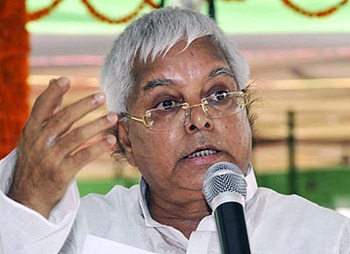
If you haven’t heard of Bihar’s fodder scam of 1996, you might still be able to recognize it by the name of “Chara Ghotala,” as it is popularly known in the vernacular language.
In this corruption scandal worth Rs.900 crore, an unholy nexus was traced involved in fabrication of “vast herds of fictitious livestock” for which fodder, medicine and animal husbandry equipment was supposedly procured.
7) The Hawala Scandal
The Hawala case to the tune of $18 million bribery scandal, which came in the open in 1996, involved payments allegedly received by country’s leading politicians through hawala brokers. From the list of those accused also included Lal Krishna Advani who was then the Leader of Opposition.
Thus, for the first time in Indian politics, it gave a feeling of open loot all around the public, involving all the major political players being accused of having accepted bribes and also alleged connections about payments being channelled to Hizbul Mujahideen militants in Kashmir.
8) IPL Scam
Well, I am running out of time and space over here. The list of scandals in India is just not ending and becoming grave by every decade. Most of us are aware about the recent scam in IPL and embezzlement with respect to bidding for various franchisees. The scandal already claimed the portfolios of two big-wigs in the form of Shashi Tharoor and former IPL chief Lalit Modi.
Although not corruption scams, these have affected many people. There is no way that the investor community could forget the unfortunate Rs. 4000 crore Harshad Mehta scam and over Rs. 1000 crore Ketan Parekh scam which eroded the shareholders wealth in form of big market jolt.
India and the US on Tuesday inked a pact on cybersecurity to intensify information exchange on threats to computers and networks and initiate joint work on technologies against cyber-attacks.
A joint statement on the India-US strategic dialogue has announced the cybersecurity agreement among new initiative by the two countries. These initiatives also include a plan to develop a software platform to make available non-sensitive government data to the public and to award $3 million each year to entrepreneurial projects that commercialise technologies to improve health.
A memorandum of understanding between the Indian and the American Computer Emergency Response Teams (CERT) is expected to lead to routine exchange of information on vulnerabilities and co-operation on cybersecurity technologies, Indian CERT officials said.
"This comes at a time when cybersecurity-related incidents are increasing in number and becoming more and more sophisticated," said Gulshan Rai, director-general of the Indian CERT, a division of the ministry of communications and information technology.
Rai said the MoU is expected to lead to greater exchange of information between Indian and US CERTs about known and emerging threats, specific vulnerabilities of computers and networks and open opportunities for joint technology development.
The CERTs track and catalogue threats, advocate protective mechanisms, and respond to attacks on computer systems in the two countries. The latest monthly security bulletin from India’s CERT says 151 computer security-related incidents were reported during May 2011 alone, among which more than half involved “phishing” — an attack or an intrusion that involves some form of identity theft.
Last year, unidentified hackers, believed to be based in China, had penetrated computers in sensitive Indian government offices, including the National Security Council secretariat, and stolen documents on missiles, and personal and financial data of Indian officials.
India already has cybersecurity pacts, primarily for the exchange of information, with Japan and Korea and is planning to develop one with Finland, Rai told The Telegraph. The cybersecurity pact followed consultations led by the Indian and the US National Security Councils on prospects for bilateral co-operation on cybersecurity issues, held on Monday, a joint statement on the India-US strategic dialogue said.
The joint statement also said the Nasa has "reiterated its willingness to discuss potential co-operation with the Indian Space Research Organisation on human spaceflight". While the Nasa offer comes on the eve of the retirement of the US Space Shuttle, space experts believe Nasa has accumulated enormous expertise on human spaceflight — for instance, in the area of onboard life support systems — that could help India in its own long-term plans to develop a space capsule large enough to carry two astronauts into a low-earth orbit for a short mission.
The open source software platform that India and the US plan to create is intended to help make available to the public all non-sensitive government information through a user-friendly website. It is expected to be patterned on the lines of America’s own government data website www.data.gov which began with 47 government data sets in May 2009, but has more than 392,000 data sets today.
"We have all kinds of data there — data sets on infant car seats, airline statistics, hospitals," said Aneesh Chopra , the chief technology officer in the US, who is also assistant to US President Barack Obama.
An Indian government official said India is preparing a policy initiative to get myriad government departments into making non-sensitive data — from education to health to public infrastructure — public through a so-called National Data Sharing Access Policy (NDSAP). The official who spoke on condition of anonymity said this NDSAP is yet to be approved by the Union Cabinet.
Among other initiatives, the India-US science and technology endowment board established in 2009 has decided to award $3 million annually to projects proposed by entrepreneurs for commercialisation of technologies to improve health and empower citizens.
The first call for proposals has already attracted more than 380 joint India-US proposals and the first set of awards will be announced in September this year.
India on Friday successfully launched its latest communication satellite GSAT-12 onboard a powerful variant of homegrown Polar Satellite Launch Vehicle, PSLV-C17, from the spaceport in Sriharikota.
In a textbook launch, Indian Space Research Organisation’s workhorse PSLV lifted off from the second launch pad of the Satish Dhawan Space Centre here at 4.48 pm at the end of the 53-hour countdown and placed the 1,410 kg GSAT-12 into orbit about 20 minutes later.
“I am extremely happy to state that the PSVL-C17 GSAT12 mission is successful. The launch vehicle injected the satellite very precisely into the intended orbit,” a beaming ISRO Chairman K. Radhakrishnan announced.
On its 18th successful mission in a row, the PSLV zoomed into cloudy skies as scientists broke into cheers at the mission control centre here, 90 km from Chennai.
GSAT-12 was injected into an elliptical Transfer Orbit of 284 km perigee (closest point to Earth) and 21,000 km apogee (farthest point to Earth).
Subsequently, the onboard Liquid Apogee Motor would be used to place the satellite in a circular orbit.
GSAT-12, aimed at augmenting the capacity in the INSAT system for various communication services like tele-education, tele-medicine and Village Resource Centres, would be co-located with INSAT-2E and INSAT-4A satellites.
This was the second time in its 19 flights that the PSLV has been used for launching a communication satellite after Kalpana-1 in 2002.
ISRO used the most powerful XL configuration with six extended solid strap-on motors carrying 12 tonnes of solid propellant as against nine tonnes for the standard PSLV for Friday’s flight. A similar configuration was used for launching India’s maiden Chandrayaan-1 lunar mission in 2008.
ISRO chose its reliable launch vehicle PSLV in the face of failures of two previous GSLV flights in April and December 2010 that dealt a blow to the missions to place GSAT-5 and GSAT-5P into orbit causing transponder shortage.
Launch of GSAT-12, equipped with 12 Extended C-band transponders, is expected to partly meet the country’s growing demand for transponders in a short turnaround time.
The satellite, with a mission life of about eight years, and the PSLV together cost about Rs 200 crore.
Mr. Radhakrishnan said Prime Minister Manmohan Singh has extended his warm congratulations to the ISRO team on the successful launch of GSAT-12.
He said in the coming months ISRO would undertake a series of PSLV missions for launching several satellites.
According to him, the GSAT-12 would cater to tele-medicine and tele-education services and ‘more importantly’ provide support for disaster management.
The ISRO chief also said the space agency had an agenda for a reliable GSLV cryogenic stage (indigenous) “which will happen in a year.
“The ISRO team will pursue this with grit and determination.”
India’s ambitious home grown cryogenic stage programme has met with failures of two GSLV rockets -- in April and December 2010.
Lauding the efforts of ISRO team, Union Minister of State in PMO V Narayanasamy said this launch would help the country in meeting requirement for more transponders.
ISRO officials said the GSAT-12 and all parameters were 'healthy’.
Pushed to the wall after CBI named him in the 2G spectrum allocation case, high-profile Textiles Minister Dayanidhi Maran today resigned from the Union Cabinet, becoming the second DMK casualty in the scam.
44-year-old Maran met Prime Minister Manmohan Singh after a Cabinet meeting and tendered his resignation following a word from DMK chief M Karunanidhi, highly-placed sources said.
Maran's continuance in the Cabinet became untenable after the CBI in its status report on the 2G scam case yesterday, charged him with "forcing" a Chennai-based telecom promoter C Sivasankaran to sell his stakes in Aircel to a Malaysian firm in 2006 during his tenure as Telecom Minister in UPA-I.
The Prime Minister is believed to have had a word with DMK Parliamentary Party chief T R Baalu this morning and conveyed to him that the DMK leadership should be apprised of the position that Maran cannot continue in the cabinet.
Baalu, who is in Delhi, is understood to have conveyed this to Karunanidhi who later asked Maran to put in his papers.
It was business as usual for Maran in the morning as he attended the Cabinet meeting during which he abstained himself for a brief while when the issue of licence for FM channels came up.
He kept himself away on account of conflict of interest because his brother Kalanidhi Maran runs a media empire that includes FM channels in various languages.
Maran went back home from the Cabinet meeting and returned later to give his resignation to the Prime Minister on the DMK chief's direction.
Maran, son of late Union Minister Muralosi Maran, is a grand nephew of Karunanidhi.
With this, Maran becomes the second DMK minister to step down for alleged involvement in 2G scam. Former Telecom Minister A Raja was forced to resign in November, 2010 when the CAG indicted him in the scam.
Karunanidhi's daughter and DMK MP Kanimozhi and Raja are currently in Tihar jail for their alleged involvement in the scam.
This is the second time Maran is quitting the Cabinet. The first time he quit was in 2007 when the DMK decided to withdraw him from the Cabinet after differences cropped up within the DMK's first family.
Later, he made a re-entry into the Cabinet in May, 2009 after the elections, but got only the Textiles portfolio.
The CBI, in its report, also said that during 2004-07 when Maran was telecom Minister, Sivasankaran, was forced to sell the stake in Aircel to a Malaysian firm Maxis Group.
There was intense speculation for the past one month about Maran's continuance in the Union Cabinet after reports alleging that the family-owned Sun TV received pay-offs from a Malaysian firm in return for the spectrum alloted to it during Maran's tenure surfaced.
New Delhi: A day after the CBI practically implicated Dayanidhi Maran in the 2G spectrum scam, the Textile Minister and former telecom minister on Thursday quit the Union Cabinet.
Neither being a media baron nor being Karunanidhi's grand nephew could help Maran save his Cabinet post.
The moment the CBI told the Supreme Court that it is probing the 2G case against Maran, it was clear that he had to resign, but the question was 'when'.
The answer came at the cabinet meet on Thursday morning. Sources said Prime Minister Manmohan Singh conveyed to him that his position was untenable.
Soon after the meet, Maran, who was defiant till then, went back to the PMO to hand over his resignation.
Dfending Maran, Karunanidhi said, "The Media has been ruling in India and if it wants it can defame anyone, Dayanidhi Maran is no exception".
Karunandhi also denied reports that he gave the go-ahead to Maran to resign after speaking to Prime Minister Manmohan Singh and Congress President Sonia Gandhi on Wednesday night.
"No body from the UPA or the Congress has contacted me. I did not speak to Sonia Gandhi last night," said Karunanidhi.
Despite the blow to the DMK, the Congress said ties with their Tamil Nadu allies remain strong.
"The DMK has been the alliance partner of the UPA since 2004 both at the Centre and in the state and the situation stays as such," said Congress spokesperson Manish Tewary.
Sources say that the Congress had communicated the decision to the DMK on Wednesday. Weakened by the election defeat the DMK was in no position to back its minister.
Adding to it was internal rivalry. Maran who is Karunanidhi's grand nephew has been seen as arch rival of DMK chief's daughter Kanimozhi Karunanidhi and sections within the party have been gunning for him. But the biggest winner is perhaps Tamil Nadu Chief Minister J Jayalalithaa.
"This is something long overdue. The Prime Minister should have made him to resign long ago," Jayalalithaa said.
"The PM has to take a call. He inducted a person despite conflict of interest. This grievance has been made, he should have known better," said BJP leader Arun Jaitley.
Jayalalithaa has already been cracking down on those connected to Maran family's Sun Network and the company stocks took a huge beating after news of Dyayanindhi's resignation.
Resigning from the Cabinet may just be the beginning of troubles for Dyaynidhi Maran. He is most likely to be questioned by the CBI in the case, and how it proceeds further could determine his political future.