Showing posts with label Facebook. Show all posts

Friday, 5 April 2013

Facebook aims to take centerstage on Android phones

MENLO PARK, California (Reuters) - Facebook Inc on Thursday unveiled its most ambitious attempt yet to enter mobile computing without a phone of its own, introducing a new app that replaces the home screen on some Android smartphones.
Called "Home," the new software lets users comprehensively modify Android, the popular mobile operating system developed by Google, to prominently display their Facebook newsfeed and messages on the home screens of a wide range of devices - while hiding other apps.
"Why do we need to go into those apps in the first place to see what's going on with those we care about?" Facebook Chief Executive Mark Zuckerberg told the hundreds of reporters and industry executives gathered at the company's Menlo Park campus.
"We want to bring all this content to the front."
The "Home" software will be available for download for free from Google Play starting April 12. In addition, AT&T Inc has exclusive rights to sell for $100 the first handsets, made by Taiwan's HTC Corp, that come pre-installed with the software starting the same day. France Telecom's Orange will be offering the phone in Europe.
Shares in Facebook finished trading up 82 cents, or 3.1 percent, at $27.07; Google stock closed at $795.07, down $11.13 or 1.38 percent.
Analysts say should the new software take off, it may begin to draw users away from Google services. Offering Facebook messaging, social networking and photos on the very first screen that Android users see could divert attention from the panoply of services, such as search and email, which generate advertising revue for Google.
Instead of traditional wallpaper or a "lock screen," users with Home installed will see a new Facebook "cover feed" that displays a rolling ticker-tape of photos, status updates - and eventually, ads - from Facebook's network.
Facebook's executives, acknowledging that messaging and communications remain the most fundamental use for smartphones, also showed off a new "chat heads" messaging interface, which would combine SMS text messages and Facebook chat messages under one tool.
"On one level, this is just next mobile version of Facebook," Zuckerberg said. "At a deeper level, this can start to be a change in the relationship with how we use these computing devices."
People who used the software and the HTC phone on Thursday appeared impressed by the highly visual design and interface that featured a multitude of pictures. But analysts say the jury is still out on whether Home has appeal beyond habitual Facebook users.
Some were skeptical consumers would leap at the chance to make Facebook so central to their lives.
"Facebook thinks it's more important to people than it actually is," said Charles Golvin, an analyst at Forrester Research.
Golvin said that in markets like Spain and Brazil, mobile users spend far more time in messaging apps like Whatsapp compared to the Facebook app.
"For the vast majority of people, Facebook just isn't the be-all and end-all of their mobile experience. It's just one part," he said. "I see a more apathetic response among Facebook users than Facebook might be expecting."
COMPETITION WITH GOOGLE
Facebook's wide-reaching mobile strategy could heighten its competition with Google, the dominant Internet search engine and the developer of Android with whom it is locked in a battle for Internet users' time online and for advertising dollars. But if it proves to be popular among Android users, Home could also place the two companies in something of an uneasy partnership.
More than 750 million mobile devices featuring Android have been activated to date, according to Google, more than gadgets based on Apple Inc's iOS, the runner-up.
Zuckerberg downplayed the rivalry even as he praised Google's willingness to let other companies tinker with Android. He said he was confident Google would not make changes to Android that would hamstring Facebook.
"If 20 percent of time people are spending on their phones is in Home, I really think they're going to have a hard time making a rational decision" to limit Home's functionality, Zuckerberg told reporters.
Google issued a neutral statement, saying the new phone demonstrated Android's openness.
"The Android platform has spurred the development of hundreds of different types of devices," the company said. "This latest device demonstrates the openness and flexibility that has made Android so popular."
Not everyone is sure that Google will remain neutral.
"Google has made Android open, but as they release the next version, are they going to be as open?" said Simon Mansell, the chief executive of TBG Digital, an advertising technology provider. "Facebook is hiding all the Google stuff with their own stuff, and how Google will respond is interesting."
For Facebook - founded in Zuckerberg's dorm room in 2004 as a website - bolstering its mobile presence is critical. Nearly 70 percent of Facebook members used mobile devices such as smartphones and tablets to access its service at the end of 2012, and 157 million of Facebook's roughly 1 billion users accessed the service solely on a mobile device.
The company has stepped up efforts to ensure that its revenue-generating ads can be viewed on mobile devices and Zuckerberg has said that the company's engineers are now focused on creating "mobile-first experiences."
Zuckerberg said features like cover feed will be ad-free initially, but he envisioned advertising as another form of content that will eventually be integrated. Analysts say the company treads cautiously when introducing ads into any of its services, wary of infuriating users.
"This is about becoming more deeply embedded in the operating system on mobile devices, and creating a broader platform," said Jan Dawson, chief telecoms analyst for the research firm Ovum. "It will allow Facebook to track more of a user's behavior on devices, and present more opportunities to serve up advertising."
But "that presents the biggest obstacle to success for this experiment: Facebook's objectives and users' are once again in conflict. Users don't want more advertising or tracking, and Facebook wants to do more of both."
Reports that Facebook was developing its self-branded smartphone have appeared sporadically and Zuckerberg has shot them down, as he did again on Thursday.
But with specialized software that adds a layer on top of Android, Facebook may get many of the benefits of having its own phone without the costs and risks of actually building a hardware device, analysts said.
"It's much lower risk than developing a phone or an operating system of its own, and if it turns out not to be successful, there will be little risk or loss to Facebook," Dawson said. "If it does turn out to be successful, Facebook can build on the model further and increase the value provided in the application over time."

Thursday, 7 March 2013

Social networking app Path adds private messaging, stickers in v3.0 update

path_3_ios.jpg
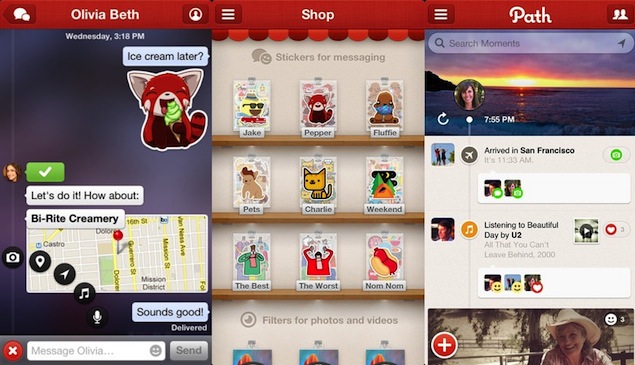
Path v3.0 for iOS and Android brings two new features to the popular social networking app - private messaging and stickers.
Private messaging is exactly what the name suggests, letting users communicate with each others privately using text, location (e.g. letting someone know where you are), photos, videos, the newly introduced stickers and more. Users can also leave each other a voice memo using private messaging. As Private messaging can be one-on-one or in a group of up to 15 people.
Path calls stickers fun pieces of art that can be used for expressing yourself in public or private messaging. Path has bundled a bunch of stickers like 'The Best', 'The Worst', 'Nom Nom' and others. Users can buy additional stickers from the newly introduced store. 'The Shop' also features additional photo filters that users can pick up at a cost.
Path founder Dave Morin told The Next Web, that it is on track to introduce a subscription-based in the first half of 2013, but did not offer any details on what additional features the service will offer to paying customers.
Path 3 is available in 19 languages for iOS and Android devices from the App Store and Google Play.
Path v3.0 for iOS and Android release notes
  • Messaging - The fast, fun, and private way to message your family and friends one-to-one or in small groups. Use your words, your voice, your location, media, stickers, and more!
  • Stickers - Say more in a single tap with handcrafted stickers from some of our favorite artists.
  • The Shop - The hand curated place to find premium photo filters and handcrafted stickers to make your Path experience more you.
  • Performance improvements.
  • Bug fixes.

Facebook appoints former Genentech executive Desmond-Hellmann

facebook-data-635.jpg
Facebook Inc appointed a former Genentech executive to its board of directors on Wednesday, the social networking company's latest move to expand its boardroom following its initial public offering last May.Susan Desmond-Hellmann, the Chancellor of the University of California, San Francisco, becomes Facebook's ninth director and the second woman on its board.
A former president of product development at Roche Group-owned biotechnology company Genentech, Desmond-Hellmann also sits on the board of directors of Procter & Gamble Co.
Facebook Chief Executive Mark Zuckerberg cited Desmond-Hellmann's experience shaping public policy and operating public companies.
Desmond-Hellmann will serve on the board effective immediately, but will have to be elected by shareholders, along with the other Facebook directors, at the company's annual meeting in June.
Facebook Chief Operating Officer Sheryl Sandberg joined Facebook's board in June 2012, a month after the company's rocky initial public offering.
The world's No. 1 online social network became the only U.S. company to debut with a market value of more than $100 billion. But its shares plunged more than 50 percent in the months after the IPO on concerns about its long-term money making prospects.
Facebook shares have rebounded roughly 56 percent from their 52-week low, finishing Wednesday's regular trading session at $27.45.

Facebook to keep its users engaged

facebook_screen_logos.jpg
Facebook plans to announce on Thursday a substantial redesign of its News Feed - a makeover aimed at both keeping users glued to the social network and luring more advertising dollars.Company executives have broadly said they want to make the News Feed, the first page every user sees upon logging in, more relevant.
In an earnings call with Wall Street analysts in January, the company's founder and chief executive, Mark Zuckerberg, offered some hints of what a reimagined News Feed might look like: bigger photos, more videos and "more engaging ads."
"Advertisers want really rich things like big pictures or videos, and we haven't provided those things historically," Mr. Zuckerberg said at the time.
Facebook declined to comment on the redesign, which is scheduled to be announced at its headquarters in Menlo Park, Calif. But the adjustments will reflect the tricky balance Facebook faces now that it is a public company to keep drawing users to the site while not alienating them with more finely targeted advertisements, which is Facebook's chief source of revenue.
The pressures are acute, given Facebook's still anemic performance on Wall Street. It came out of the box last May with an extraordinarily high valuation of $38 a share, which slumped to half last fall, and has remained for the most part under $30.
"They have to walk a fine line between the user's needs and advertiser's needs," said Karsten Weide, an analyst with IDC. The user, he went on, could use "better, more intelligent filtering," while the advertiser needs "smarter, more flexible advertising formats."
Facebook's challenge is all the more important considering some warning signs of boredom.
Earlier this year came worrying news that 61 percent of users had taken a sabbatical from the social network, sometimes for months at a time; boredom was one of the reasons cited in the survey by the Pew Research Center. Even worse, 20 percent had deactivated their account entirely.
Advertisers have for years wanted to find new ways to show targeted ads to Facebook users, based on the vast data that the social network has about them. But Facebook has at times run into problems with new advertising products.
For example, last year, just before it filed for its public offering, it began to show advertisements in the News Feed, largely in the form of the controversial Sponsored Stories, where one user's "like" for a brand was deployed to market that brand to a user's Facebook "friends."
Last fall, again in an effort to drum up new revenue, Facebook offered brands and individual users a way to pay Facebook to promote a particular post on the News Feed. Those who did not pay could expect an average post to reach about a third of their Facebook friends, according to the company's own analysis. That immediately drew criticism, including from Mark Cuban, a technology investor and owner of the Mavericks basketball team, who wrote in an angry post on his blog (http://blogmaverick.com/) last fall that Facebook had made it too expensive for a brand like the Mavericks to reach its fans.
This week, responding to fresh criticism, Facebook said it did not "artificially suppress" content to feature paid posts.
The social networking giant has tweaked its News Feed over the years. Since 2009, Facebook has filtered what every user sees on the News Feed, based on the wisdom of its proprietary algorithm, called Edge Rank, which determines which posts a particular user is likely to find most interesting.
In 2010, it allowed users to chronologically filter the contents of the scrolling feed. The next year, it introduced a separate right-hand-side ticker - Twitter-esque, some said - of everything that every "friend" and brand page had posted.
At the heart of Facebook's business is to hold the attention of its one billion users worldwide. That means keeping them entertained and on the site as frequently as possible.
It seems to be losing this battle somewhat with its youngest users. Teenagers are increasingly turning to other services, including Instagram, which Facebook now owns, so much so that David A. Ebersman, the company's chief financial officer, said last week in a conference sponsored by Morgan Stanley that Facebook considered the photo-sharing site a competitor.
Instagram is not its only worry. Americans are increasingly turning to Pinterest to share shopping desires with their friends; Tumblr is a popular forum for self-expression, and Twitter continues to grow as a platform for news and entertainment.
Many people may no longer know all their "friends" on Facebook, which makes it difficult for the company to stuff the News Feed with posts that users will find relevant. Then there are ads.
"The bigger opportunity for Facebook is in cracking the relevance nut," said Travis Katz, founder of an online travel service, Gogobot, that is integrated with Facebook.
"The noise-to-signal ratio in the feed has increased dramatically," he added, "to the point where I often miss stories that were important to me."
At the Morgan Stanley conference, Mr. Ebersman said the company's filtering algorithms get "smarter" the more a Facebook user clicks on what is displayed on the News Feed.
"So of all the information we are able to show you on Facebook, we are trying algorithmically to pick out which pieces of content to put at the top of your News Feed because we think you will find them most engaging."

Facebook exec's new book urges women to 'Lean In'

facebook-coo-635.jpg
For a book that has yet to be released, Sheryl Sandberg's "Lean In" - part feminist manifesto, part how-to career guide - has got a lot of people talking.In the weeks leading up to the book's March 11 release, pundits and press hounds have been debating its merits. New York Times columnist Maureen Dowd called Sandberg a "PowerPoint Pied Piper in Prada ankle boots," and countless bloggers have suggested that Facebook's chief operating officer is the wrong person to lead a women's movement.
"Most of the criticism has to do with the position she is coming from," said Susan Yohn, professor and chair of Hofstra University's history department.
Sandberg, 43, hopes that her message of empowerment won't be obscured by the lofty pedestal from which she speaks. But is the multi-millionaire with two Harvard degrees too rich to offer advice? Too successful? Does her blueprint for success ignore the plight of poor and working-class women? Does the book's very premise blame women for not rising to top corporate positions at the same rate as men?
And just how big is her house?
The questions keep coming largely because few people have actually read the book. But in it, Sandberg seems to have foreseen much of the criticism. The book acknowledges that critics might discount her feminist call to action with an easy-for-her-to-say shrug.
"My hope is that my message will be judged on its merits," she writes in the preamble.
Sandberg recognizes that parts of the book are targeted toward women who are in a position to make decisions about their careers. Still, she writes, "we can't avoid this conversation. This issue transcends all of us. The time is long overdue to encourage more women to dream the possible dream and encourage more men to support women in the workforce and in the home."
Published by Alfred A. Knopf Inc., "Lean In: Women, Work and the Will to Lead" will be launched Thursday with a reception in New York City hosted by Mayor Michael Bloomberg and Arianna Huffington.
It's true that Sandberg is wealthy. She also has a supportive husband. Mark Zuckerberg is her boss. And, yes, her home is a 9,000 square-foot mansion in Menlo Park, Calif.
But as a woman in Silicon Valley, Sandberg hasn't exactly had it easy, and her tale shows she's no armchair activist. After all, not many women would march into their boss' office and demand special parking for expectant mothers. But Sandberg did just that when she worked at Google. Company founders Larry Page and Sergey Brin complied.
After Sandberg moved to Facebook in 2008, she became even more outspoken on the issues facing women in corporate America. At a time when other executives, male or female, have largely stayed quiet, Sandberg has delivered speeches on topics such as "Why we have too few women leaders."
And she's no workaholic. In an age of endless work hours, Sandberg is famous for leaving the office at 5:30 to spend time with her family. She does admit, however, to picking up work once her kids have gone to bed.
Of the many inspirational slogans that hang on Facebook's walls, her favorite asks "What would you do if you weren't afraid?" "Lean In" is about pushing past fear.
"Fear is at the root of so many of the barriers that women face," she writes. "Fear of not being liked. Fear of making the wrong choice. Fear of drawing negative attention. Fear of overreaching. Fear of being judged. Fear of failure. And the holy trinity of fear: the fear of being a bad mother/wife/daughter."
Sandberg peppers the book with studies, reports and personal anecdotes to back up her premise - that for reasons both in and out of their control, there are fewer woman leaders than men in the business world and beyond. For example, the Fortune 500 has only 21 female CEOs. Sandberg is among the 14 percent of women who hold executive officer positions and the 16 percent of women who hold board of director seats, according to Catalyst.org.
For minority women, the numbers are even bleaker. Women of color, she writes, hold just 4 percent of top corporate jobs and 3 percent of board seats.
"A truly equal world would be one where women ran half our countries and companies and men ran half our homes. I believe that this would be a better world," she writes. "The laws of economics and many studies of diversity tell us that if we tapped the entire pool of human resources and talent, our collective performance would improve."
At less than 200 pages, plus a good chunk of footnotes, "Lean In" does not purport to be the end-all solution to inequality. It deals with issues Sandberg sees as in women's control.
"Don't leave before you leave" is one of her catchphrases, aimed at successful women who gradually drop out of the workforce in anticipation of children they may someday bear. "Make your partner a real partner" is another. She says everyone should encourage men to "lean in" at home by being equal partners in parenting and housework.
"Lean In" is, by and large, for women who are looking to climb the corporate ladder (which Sandberg calls a jungle gym), and ideally their male supporters. She hopes it's the start of a conversation. To that end, Sandberg plans to donate all of the proceeds to her newly minted nonprofit, LeanIn.org.
Sandberg's book shares personal details that reveal a fair share of stumbles and lesser-known tidbits. Did you know she was an aerobics instructor in the 1980s -big hair, silver leotard and all? The book paints a picture of an exceptionally successful woman who admits to lacking confidence at various points in her career.
Sandberg writes about the "ambition gap" between men and women in the workplace - that while men are expected to be driven, ambition in women can be seen as negative. She writes about parents' gender-based approaches to child rearing that teach girls to be "pretty like mommy" and boys "smart like daddy," as she's seen on baby onesies sold at Gymboree.
And she writes about "feeling like a fraud" - that insidious notion, felt largely by women but men as well, that success is due not to her own merit but to some sort of gross oversight or accident.
Sandberg's book comes half a century after Betty Friedan's "The Feminine Mystique," which identified "the problem that has no name" among largely white, suburban housewives who felt unhappy and unfulfilled in their roles at home. Friedan, too, was criticized for focusing on a privileged swath of womankind.
"Lean In" is a call to action to make it easier for women to become leaders. It's a call for women to take space at the table, raise their hands, speak up and step up. It's a personal account of a woman who, through a mix of talent, luck and ambition, but also with plenty of internal and external obstacles along the way, managed to do that.
Feminist icon Gloria Steinem, whom Sandberg thanks in the acknowledgements and cites as inspiration, praises "Lean In" on her Facebook page, saying that it "addresses internalized oppression, opposes external barriers that create it and urges women to support each other to fight both."
She adds that even the book's critics "are making a deep if inadvertent point: Only in women is success viewed as a barrier to giving advice."

Amid chatter of 'Facebook fatigue', a new look News Feed on the way

facebook-new-look-logo-big.jpg
Amid chatter of "Facebook fatigue," real or imagined, the world's biggest social networking company is getting ready to unveil a new version of News Feed, the flow of status updates, photos and advertisements its users see on the site.

Facebook Inc. is hosting an event at its Menlo Park, Calif., headquarters on Thursday to show off "a new look for News Feed." The company offered no other details on what the changes will be in an invitation sent to journalists and bloggers. It will be Facebook's second staged event at its headquarters since the company's May initial public offering. The company unveiled a search feature at the first one in January.

If past site changes are any indication, the News Feed tweaks may take some getting used to and will likely lead to user grumbles. Facebook users often complain about changes to the site, whether it's cosmetic tweaks or the overhaul of privacy settings.

Gartner analyst Brian Blau says one change he'd like to see from Facebook as a user is the ability to control how much he's seeing from the businesses and other non-friend accounts he follows. Currently users can only tweak how much they see from their friends, not from businesses they follow.

"We have a 'like' but there is no degree of 'like,' it's binary," he says. "I need a 'like plus' or even a 'like minus.'"

The event comes a month after a Pew study reported that many Facebook users take a break from the site for weeks at a time. The report, from the Pew Research Center's Internet and American Life Project, found that some 61 percent of Facebook users had taken a hiatus for reasons that range from boredom to too much irrelevant information to Lent.

Overall, though, Facebook's user base is growing, especially on mobile devices. At last count it had 1.06 billion active monthly accounts. The number of people who access Facebook daily is also on the rise.

That said, even the company has acknowledged that some of its users, especially the younger ones, are migrating to substitutes, but so far this has not meant an overall decline in user numbers.

"For example, we believe that some of our users have reduced their engagement with Facebook in favor of increased engagement with other products and services such as Instagram," the company said last month in the "risk factors" of its annual 10-K filing. "In the event that our users increasingly engage with other products and services, we may experience a decline in user engagement and our business could be harmed."

Facebook owns Instagram, but so far it has not shown any ads on it.

Tuesday, 13 March 2012

Facebook

  1. Welcome to Facebook - Log In, Sign Up or Learn More

    www.facebook.com/Cached - Similar
    Facebook is a social utility that connects people with friends and others who work, study and live around them. People use Facebook to keep up with friends, ...

    Login


    https://www.facebook.com/login.php
    Facebook is a social utility that connects people with friends ...

    Sign Up for Facebook


    www.facebook.com/r.php
    Sign Up for Facebook. Join Facebook to connect with ...

    ¡Bienvenidos a Facebook en ...


    blog.facebook.com/blog.php?post=10005792130
    Last week, Facebook launched a Spanish version of the site that ...

    Forgot your password?


    www.facebook.com/recover.php
    Facebook is a social utility that connects people with friends ...

    Facebook Profile


    www.facebook.com/about/profile/
    Facebook is a social utility that connects people with friends ...

    Create a Page


    www.facebook.com/pages/create.php
    Facebook is a social utility that connects people with friends ...
  2. App Store - Facebook

    itunes.apple.com/in/app/facebook/id284882215?mt=8Cached
    18 Dec 2011 – Description. Facebook for iPhone and iPad. Facebook for iPad. With high-res photos, games, chat and more, now you can get the best of ...
  3. Facebook - Wikipedia, the free encyclopedia

    en.wikipedia.org/wiki/FacebookCached - Similar
    Facebook is a social networking service and website launched in February 2004, operated and privately owned by Facebook Inc. As of February 2012, ...
  4. Facebook for Android - Apps on Android Market

    market.android.com › Apps › SocialCached
     2,628,082 votes - Free - Android
    16 Feb 2012 – Share and stay connected with your friends with the Facebook for Android app. Facebook for Android helps you connect with your friends and ...
  5. Facebook.com Site Info

    www.alexa.com/siteinfo/facebook.comCached - Similar
    facebook.com is one of the top 10 sites in the world and is in the We Are The 99 Percent category.
  6. Free Facebook - Download Facebook - Free Apps from BlackBerry ...

    appworld.blackberry.com/webstore/content/680/Cached
    Find Facebook for your BlackBerry Smartphone. Download Facebook by Research In Motion Limited from BlackBerry App World & discover more Apps in the ...
  7. Facebook | CrunchBase Profile

    www.crunchbase.com › CompaniesCached - Similar
    Facebook is the world's largest social network, with over 500 million users. Facebook was founded by Mark Zuckerberg in February.
  8. News for facebook

    The Daily Star
    1. Zynga seeks own game space away from Facebook
      Reuters India‎ - 1 hour ago
      O) is launching a new games service that allows users to play on the company's website instead of Facebook, potentially driving traffic away from the ...
  9. Facebook: Complete coverage - Computerworld

    www.computerworld.com/s/article/.../Facebook_Complete_coverageCached - Similar
    Latest news about Facebook, plus opinions, blogs, features and more.
  10. Facebook Programming Challenge - Facebook - Interviewstreet

    facebook.interviewstreet.com/recruit/challengesCached
    How does this work? Take the timed challenge. If your code passes the test, you will be contacted for a telephone interview. If your code is too similar to another ...
  11. It Gets Better: Facebook Employees - YouTube

    www.youtube.com/watch?v=iPg02qjL40gCached - Similar
    26 Oct 2010 – http://youtube.com/theofficialfacebook Facebook employees share their stories for the It Gets Better Project. Learn more at ...

How to Set Facebook Chat Offline

Sometimes Facebook users just want to stalk without interruption.
Facebook Chat, while a useful tool for chat, can be a constant source of interruption from your social network activities. So, what do you do?


For users who wish to set Facebook Chat offline, the "Options" section allows users to block incoming IMs and a number of other settings.

Users who set Facebook Chat offline do not appear to their friends on the contacts list, even while browsing their accounts.

Users can also appear offline on Facebook Chat to individual friends, so you can continue to use the Facebook Chat client while avoiding people you do not want to IM with.

Wednesday, 30 November 2011

How to Hide Your Friends on Facebook

How to Hide Your Friends on Facebook 

Do you want to hide your list of friends from people in it? Since May 2010 Facebook offers again the possibility to stop showing them on your profile. This guide will show you how to do it.

Once you have logged in to Facebook, on the top right hand corner of the page, click on your name or small profile picture and then on the “Edit Profile” button that will appear right below.

Once you have done this, in the left sidebar, click on the option that says “Friends and Family.”


Now, at the right extreme of the Friends section, located near the bottom center of the screen, click on the audience icon, the one indicated in the next image, and in the appearing menu select the option “Only Me.”


Finally, click on the “Save Changes” button, located near the bottom of the screen.

Monday, 21 November 2011

Is Facebook taking over social bookmarking sites?

Is Facebook taking over social bookmarking sites?


When was the last time that you used a social bookmarking site like Digg, Stumble Upon or Reddit?

Recently, social bookmarking sites have been increasing noticeable drop in their traffic and user activity. Social bookmarking sites used to be very popular but every since Facebook entered the market, their popularity deteriorated. People seem to like sharing articles on Facebook more than they like doing it on Digg or Reddit.

Why is that the case?

It could simply be the idea of sharing the links with your friends and family and not total strangers. Of course, some people like to share their articles with strangers to get a variety of perspectives. But others prefer engaging in discussions and revealing any details only to people they know.

How does that affect webmasters?

Well, when you share articles with your friends on Facebook, they are only seen by your friends and probably their friends. When you share articles on social bookmarking sites like Digg, they are seen by millions. You get my point. But don't get upset, there are other ways to utilize Facebook to gain traffic like Facebook Pages.

VMware Cloud Learning Video's

Here is a nice summary list of all VMworld US 2018 Breakout session with the respective video playback & download URLs. Enjoy! Bra...